


banner small

News in Brief

News in Brief

Mark Montgomery, compliance manager at Smurfit Kappa Recycling, said: Our 70 drivers work shifts, which means that they can start as early as 4am and may not finish until 11pm. As they may work in the dark, collecting recyclable paper and cardboard from skips and containers, we were conscious that they could be vulnerable if they had an accident, were taken ill or injured. We therefore decided to investigate lone worker solutions that would provide them and us with peace of mind knowing that they could raise the alarm in the unlikely event of something happening to them.

Smurfit Kappa adopts system to protect lone workers

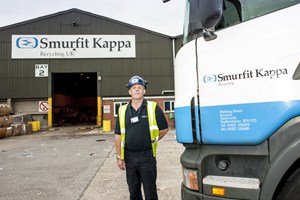
Paper recycling firm Smurfit Kappa Recycling has adopted security system Identicom, in a bid to ensure the safety of its drivers when they are working alone.
A Smurfit Kappa worker wearing the Identicom ID badge

Supplied by Connexion2, the Identicom solution comes in the form of an identity badge and allows users to make an audio call at the push of a button to a nominated alarm receiving centre where events can be assessed, recorded and responded to. It also comes with Man Down detection which alerts the centre if the user becomes incapacitated.The i777 solution, used by Smurfit Kappa Recycling, is fitted with GPS which allows the user to communicate their location.

Sackers invest in work wear to promote health and safety

Suffolk recycling firm Sackers Recycling has invested in branded high visibility work wear as part of its safety programme in a bid to ensure its staff are kept safe while at work.
Members of the Sackers team in their hi-vis work wear

The Great Blakenham-based firm has also invested in work wear for its office staff in order to promote the brand. The family-run firm handles scrap metal, commercial and industrial waste as well as coordinating its fleet of skips, containers and haulage vehicles at its site.

Commenting on the new work wear, commercial director Nigel Slinn said: Of course it is good for our staff to all feel part of the same workforce, with the same values we all share at Sackers. But the more serious issue is one of care for our staff and customers, as we work in a sector of industry which has seen nine deaths between June 2012 and September 2012. This is very much a proactive health and safety move on our part, as well as making the staff look and feel good too.

Oxford business sign up to food waste trial

More than 80 businesses in Oxford have signed up to a food waste collection trial, in a bid to divert the waste away from landfill.
The trial sees food waste collected from the 88 businesses including pubs, colleges and conference centres and then sent to Agriverts anaerobic digestion plant in Cassington, near Witney. Oxfordshire county council offers the free trial to businesses for a period of three months after which time they can choose to transfer to the councils chargeable waste scheme.

Work began on expanding the scheme at the beginning of the year, when 21 businesses were originally registered.

Councillor John Tanner, board member for a Cleaner, Greener Oxford, said: The trial is going extremely well and well done to the 88 Oxford businesses and colleges that are using the scheme. Since the trial started in November 2011, the city council has collected 270 tonnes of food waste for re-processing which is fantastic news. Thats enough to generate 147,000 kilowatt hours of electricity.

Charity calls for government support for reuse

The government needs to help facilitate a circular economy by stimulating markets for recycled goods through effective procurement policies, according to the Hyndburn Used Furniture Store (HUFS) a Lancashire-based furniture reuse and employment charity.
Jayne and Joe are the first recipients of an 80% post-consumer mattress from Lancashire charity Hyndburn Used Furniture Store, HUFS

The comments came after the WRAP annual conference last week (November 6), which focused on the importance of a circular economy (see letsrecycle.com story).
HUFS said it has closed the loop and is now able to manufacture mattresses from 80% post-consumer materials to supply to people in need.
Michael Miller, HUFS volunteer director, said: Firstly, I would ask WRAP and Defra to look for innovation and examples of the circular economy in action at the community scale, as well as multinational companies.

Secondly, government procurement policies need to facilitate markets for recycled content products and stimulate markets for remanufacture to help close the loop. There is no reason why services like ours should not exist across the country we just need the incentives and policies to support innovation and a circular economy.

WEEE recycling supports Children in Need

PC World and Currys’ technology and support service KnowHow has launched a campaign which will see the money gained from recycling waste electrical and electronic equipment (WEEE) donated to the BBCs Children in Need charity.

The campaign is also being supported by Environcom which will be recycling the materials collected. All of the proceeds raised from the recycling of small electrical items between November 9 and December 11 2012 will be donated to the charity. Items can be donated for recycling at Currys or PC World stores, or collected by the KnowHow team when a new item is delivered.

The KnowHow team delivers and collects products on behalf of Currys and PC World some of which are taken for recycling. KnowHow offers a range of services and advice on electrical goods which are delivered by its technicians, engineers, installation experts and technology experts.

Plastic piping from London 2012 recycled

Lincolnshire-based plastic recycler CKN Holdings Ltd has recently completed a project to recycle redundant water pipe following 2012 London Olympic Games.

Working in conjunction with a local partner APR, CKN Holdings Ltd has collected and prepared the plastic piping ready for recycling. The material came from eight temporary pools at the Olympic Park and is estimated to comprise of over 4,000 individual lengths.

The piping will first be separated into polymer types before being granulated – shredded into small pieces. The granules, also known as regrind, will then be used instead of virgin materials and will go into making a range of new products, such as guttering, equestrian products or piping.

Register for free to comment

Subscribe to receive our newsletters and to leave comments.

The Blog Box

Back to top

Subscribe to our newsletter

Get the latest waste and recycling news straight to your inbox.

Subscribe