


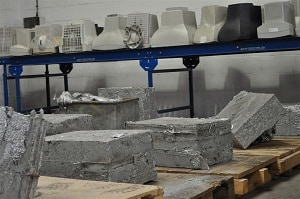
SWEEEP furnace acquisition big jump for CRT recycling

The lead extraction furnace has been purchased from Manchester-based Nulife Glass to provide a way to recycle pure CRT glass and lead in response to falling demand for the material to be used in new CRT-based TVs. Previously, TVs containing CRT glass were recovered and used in a closed-loop process, but the move towards flat screen TVs means the market for CRT sets had fallen. As a result of this, safe end-of-life solutions for the material are diminishing, while there is expected to be an influx of CRT WEEE as more people replace old sets. The furnace, which is expected to be up and running in six months time, works by heating up the glass to over 1,000 degrees centigrade, a compound is then added so the glass and lead separate with the glass rising to the top and the lead sinking to the bottom.
Patrick Watts, managing director of SWEEEP/Kuusakoski, said: Four years ago, people would actually buy the glass from us because there was demand for the new CRT televisions but slowly this price has moved down from a positive to a negative to the point where, as demand for the glass decreased, it would now costs us 80 per tonne to have it processed to make it suitable for CRT re-use. This price is only ever going up as glass demand goes down.
He added: So what do we do? Dumping it in landfill is very expensive because the material is hazardous and we need to recycle because the WEEE industry has recycling targets to meet. So that is why we have invested in the furnace. I am very happy that the furnace will provide a solution for the WEEE industry.
Welsh government unveils 14m SME reprocessing fund
A 14 million initiative which aims to help businesses in West Wales and the Valleys to reduce waste and recycle more by providing financial support for new reprocessing projects has been launched.
The Accelerating Reprocessing Infrastructure Development (ARID) project will offer small to medium sized enterprises (SMEs) in the recycling, reprocessing and manufacturing sectors financial support of up to 40% for capital investments to a maximum of 50,000. Recycling service providers looking to increase recycling amongst SMEs and manufacturers seeking to use recycled content in their products or packaging are eligible for support under the scheme. Backed with 6 million from the European Regional Development Fund through the Welsh Government, ARID will also offer financial assistance of up to 500,000 for companies investing in new or expanded, recycling and reprocessing facilities for commercial and industrial waste. The project is being led by WRAP Cymru, runs until March 2015, and aims to support up to 49 enterprises.
Launching the scheme, Welsh environment minister John Griffiths said: “Promoting resource efficiency by re-using and recycling in industry will help minimise the production and landfill of waste, bringing huge benefits for the environment, economy and our well-being.Towards Zero Waste outlines our goals for reducing our carbon footprint and meeting our ambitious targets of becoming a high recycling nation by 2025 and a zero waste nation by 2050.
Commercial food waste collection service reaches landmark
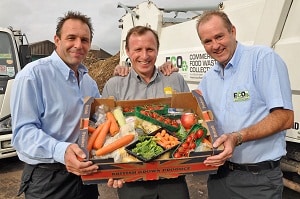
A Dorset-based commercial food waste collection service started last year has celebrated sending its one millionth kilogram of material for composting.
Ringwood-based Eco Food Recycling was set up in May 2010 and collects the food waste from schools, colleges, universities, hospitals, restaurants, pubs, canteens, leisure and theme parks across the South using its own fleet of vehicles. The company counts some of the biggest names in retailing among its clients including 18 Waitrose stores in the southern area and Bournemouths Castlepoint Shopping Park. Amounts collected have risen from 30 tonnes a month last December to the current 260 tonnes each month, a rise of 800% that has led to the company reaching the one million kilogram landmark. Food waste is delivered into Eco Sustainable Solutions Parley composting facility, where it is turned into nutrient-rich compost.
Simon Heaps, who set up Eco Food Recycling with business partner Andy Jones, said: Its a huge achievement for us but even better news for the planet. Previously the food waste would have gone to landfill but, instead, it is now being converted into compost, satisfying moral and environmental issues and enabling our clients to significantly reduce their carbon footprint.
Stevenage begins using compostable bags
Householders in Stevenage have been told they can now use compostable bags when recycling food waste in a move the Hertfordshire borough council claimed would it that bit easier to recycle the waste stream.
Previously, the unnamed composting facility which handles the local authoritys kerbside collected food waste would not accept compostable bags, and householders had to use newspaper or paper bags to store food waste in when they put it into their brown bin for collection. However, the council has now negotiated with the company so compostable bags can be used a move which it said could help reduce bad smells and also keep maggots away from the food waste. Compostable bags are made from a vegetable-based starch which means they can break down easily during the composting process. The council stressed that householders should not use degradable or biodegradable bags because they might not break down in the same way.
Councillor John Gardner, Executive member for environment and regeneration at Stevenage borough council, said, We want to make it easy for everyone to recycle as much food waste as possible. Negotiating this change to be able to collect the bags is a big step forward and we hope it will make life easier for our residents. Landfill space has become more and more sparse which has seen the price of landfill tax continue to rise steeply, so its vital that we continue to recycle more food waste. We hope that being able to use these bags will encourage more people to do just that.
Cromwell introduces SME waste collection service

Sack and bag supplier Cromwell Polythene has launched a new waste collection service for small and medium-sized enterprises (SMEs) located with a 75 mile radius of its Leeds headquarters.
The company collects materials such as polythene, hard plastics and other packaging materials and uses them in the manufacture of sacks and bags. Its recycling service already involves nationwide collections for companies which generate large volumes of post-industrial and post-consumer waste, but the new resource recovery arm will be for collecting smaller loads of typically just over one tonne of material.
We will be able to collect loads as low as 100 kilograms with the smaller vehicle that we will be operating locally, said the companys recycling director Mark Fuller. What this means is that those businesses which normally fall under the radar of the big waste management companies now have a means of recovering and recycling some of the bulkier materials from the waste stream, avoiding sending it to landfill and potentially generating an additional revenue stream. Where required, we can even help suppliers identify recoverable elements from their waste stream, providing independent advice on suitable machinery, including balers.

Register for free to comment