


Dublin extends consideration period for Poolbeg incinerator
City manager, John Tierney, told a meeting of the city council this week (September 6), that the city's four councils had decided to prolong the ‘long stop date' for the project – within which all the conditions needed for the plant to be built have to be met – beyond its original September 4 2010 expiry date and until May 2 2011. Dublin city council, which is leading the project, noted that it had spent “substantial” sums to date in land acquisition, statutory processes and client representative costs involved in the project and the councils could also have to compensate Covanta if they walked away from the deal. The project has attracted proved controversial with local residents and politicians (see letsrecycle.com story and also encountered planning issues (see letsrecycle.com story).
Mr Tierney told the meeting that the project for a 600,000 tonne-a-year capacity plant could be of “enormous benefit” to the region, while the council added that: “The Dublin Authorities, and its partners in the Project, believe that this project is essential to dealing with Dublin's waste for many years to come; that it provides good value for money for the taxpayer, as certified by the National Development Finance Agency. It will contribute to reducing our carbon footprint and will provide for electricity generation and district heating for a large area of the city.”
Quercia partners with ENER-G for landfill gas energy project

The company has joined forces with ENER-G to use the Manchester-based energy specialist's biogas generation technology to capture methane produced by the landfill and convert it into a minimum of 1136 kilowatts of renewable electricity. The 15-year project started operation in June, with ENER-G funding the initiative and paying royalties to Quercia, while – with the level of methane expected to vary over time – ENER-G is operating a ‘hire fleet' approach, which means that a larger generator can be switched for a smaller one as demand fluctuates.
Howard Rushton, operations director for Neales Waste Management and Quercia said: ‘We are committed to sourcing safe and environmentally friendly power alternatives and to continually reduce the energy used on site. We decided after much research in this subject to partner with the market leaders in this field of technology. ENER-G's ground-breaking scheme not only provides us with green energy but allows Quercia to play its part in reducing the local environment's carbon footprint, while also addressing global warming and climate change.”
BiogenGreenfinch receives ‘fact-finding' visit from Waitrose

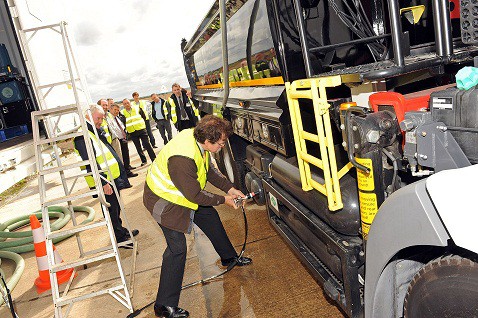
The group was shown around the company's Milton Ernest AD facility and was given a demonstration where a lorry was directly refuelled with biomethane from food waste processed at the plant. The biomethane is currently produced from food waste sent to BiogenGreenfinch's Bedfordshire plant from supermarkets including Waitrose, Whitbread, Sainsbury's, restaurants, and from local authorities, with the conversion from biogas to biomethane being made using a machine loaned by CNG Services.
Ray Collington, fleet engineer for John Lewis and Waitrose, said, “It has been great to see the whole process from the anaerobic digestion of food through to the refuelling of a lorry. Using biomethane from food waste to fuel vehicles is something that we're already trialling at John Lewis and we'll shortly be using at Waitrose too.”
Welsh fund to encourage recycled material use launched

Applications are being invited until December 2010 for the grant scheme with funding, which can be up to £50,000, being allocated on a ‘first come, first served' basis. WRAP will award successful applicants funding which can be used either for new production and packaging plants and equipment or to adapt existing equipment to facilitate the use of recycled materials. The scheme can also fund any additional initial promotional costs to ‘relaunch' a product with its enhanced level of recycled content.
Peter Webster, market development manager at WRAP Cymru, commented: “”This type of grant is a first for Wales, and for WRAP. We are confident that it will enable Welsh manufacturers to seek sources of recycled material in Wales and decrease the need for recyclable waste to be reprocessed or reused outside of Wales.
Cherwell begins food waste roll-out for flats
Cherwell district council has begun the roll out of kerbside food waste collections for its householders living in flats in Banbury this week (September 7).
The Oxfordshire local authority began introducing food waste collections in September 2009, starting in villages in the north of the district and then moving on to Kidlington in October 2009, village in the south in January 2010 and then Banbury in March 2010. But, flats were not included in the original roll-out due to many of them having no garden and therefore no green bin to put the food waste into alongside garden waste. Now, in a process that is expected to take two months, residents in flats will receive kitchen caddies, a welcome pack and complimentary liners.
Councillor George Reynolds, Cherwell's portfolio holder for environment, recreation and health, said: “This is the last big push in a project which has taken a year to roll out. I'm immensely proud of all the hard work our staff have put into this and their efforts show in the results we are achieving.”

Register for free to comment