



Commission warns Member States over waste
It has issued first written warnings to the three Baltic states of Estonia, Latvia and Lithuania because they have “not properly transposed” the WEEE Directive, which requires collection and recycling systems for waste electrical and electronic equipment.
Eight countries – Belgium, Denmark, Lithuania, Malta, Finland and Sweden – have also been sent first written warnings for failures in transposing the RoHS Directive, which bans hazardous substances in new electrical goods to reduce hazardous waste production.
And, new entrant to the EU Bulgaria has been sent a written warning because of its “lack of a system and installations for the recovery and disposal of household waste”. The Commission said waste management in the Bulgarian capital Sofia is “posing a serious risk to human health and the environment”.
Tarmac launches take-back scheme
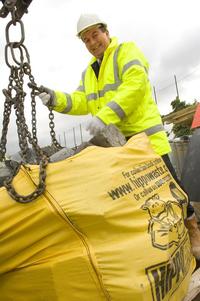
The Tarmac Topblock's Take Back Scheme will enable building sites to dispose of all broken, damaged or unused concrete blocks through the special “Hippobags” provided by the waste firm. Once 10 or more bags are full, they will be collected by Hippowaste and returned to the nearest Tarmac recycling plant, where the material will be crushed and recycled into new blocks.
The companies are expecting interest in the scheme to increase dramatically as the Landfill Tax rises and requirements for site waste management plans begin to bite next year. Alistair Whitaker, commercial director of Tarmac Topblock said: “We hope that the scheme will demonstrate the sustainability of building with concrete, and that maximising the recovery of materials is both environmentally and economically advantageous for builders.”
Irish facing incineration overload
The government of the Republic of Ireland has had a change of heart concerning the use of incineration to move the country away from landfill.
Speaking at a conference in Dublin earlier this month, minister for the environment, heritage and local government John Gormley said: “Previous policy and its over-reliance on incineration, exemplified in many regional waste management plans, is not working. It has not delivered the necessary infrastructure. But I am positive that the shift to alternative technologies such as composting and mechanical biological treatment is the way forward.”
However, the Irish minister warned that there could now be too many incineration proposals in the pipeline. Citing new figures from his department, he said a developed MBT system would mean the need for only 400,000 tonnes of disposal capacity by 2016, but that industry-proposed incineration projects could provide over two million tonnes of annual capacity.
Uncle Ben's glass reduction success

Part of the GlassRite series of trials launched in August 2006, the project run by the Faraday Packaging Partnership in Leeds and Ardagh Glass in the Netherlands has enabled a 6% reduction in the weight of Uncle Ben's sauce jars. WRAP believes turning the previously 258g jar into a 243g jar will save 450 tonnes of glass each year, and the equivalent in emissions to taking 192 cars off the road.
Nicola Jenkin from WRAP's retail team said: “Crucially, the new jar can be manufactured smoothly on our existing production lines. It has meant the creation of new moulds by our glass supplier and involved the slight increase in the diameter of the label recess area to create a smoother design, coupled with a slight reduction in the height of the jar. Together these innovations have delivered the lighter jar.”
Warwickshire parents reducing waste
More than 1,300 Warwickshire parents have managed to divert more than 1,600 tonnes of waste from landfill by using washable cotton nappies instead of the disposable alternative – saving £70,000 in waste disposal costs.
Warwickshire county council said it is continuing to encourage mums
and dads to “Cotton on to Cotton Nappies” by offering £25 cashback to parents using real nappies for their babies. It has run promotion schemes for re-usable nappies since 2004, including a network of coffee mornings where parents can find out about using washable nappies.
Cllr Martin Heatley, chair of the Warwickshire Waste Partnership and Warwickshire county council's portfolio holder for the environment, said: “Cotton nappies don't have to be about Terry squares and nappy pins! Modern nappies are shaped, come in a variety of funky colours are surprisingly soft and do not contain chemicals. They are just as easy to use as disposables and will not only save you money but will help the environment too.”

Register for free to comment