


Waste Framework Directive regulations come into force
They implement the key requirements of the Directive, such as setting a target for 50% of household waste to be collected for reuse and recycling by 2020 and introducing a legally-binding waste hierarchy which must be reflected in areas including planning and waste permitting. They also confirm that Defra does interpret the Directives requirement for separate recycling collections of at least glass, paper, metal and plastic to be introduced by 2015 to include commingled collections. This position has prompted source-separation advocates the Campaign for Real Recycling to threaten a judicial review in a bid to overturn the Departments interpretation of the Directive (see letsrecycle.com story).
The regulations, which were originally published in draft form in February 2011 (see letsrecycle.com story), came into force last week (March 29), with the exception of requirements for waste transfer notes to be changed to reflect the waste hierarchy, which must be introduced within the next six months. The regulations can be viewed here.
South West Devon waste PFI to cost less than expected

A 25-year project to treat residual household waste for three Devon councils that was formally awarded to German energy-from-waste incineration specialist MVV Umwelt last week (see letsrecycle.com story), will cost significantly less than expected, according to the local authorities involved.
The South West Devon Waste Partnership, which comprises Plymouth city, Devon county and Torbay councils, today (April 6) revealed that, while the original projected cost of the development as detailed in its bid to secure PFI funding was around 825 million, it is now expected to cost 436 million over the life of the contract. The Partnership explained that this was down to a combination of the PFI funding amounting to 177 million over the course of the contract and MVV Umwelt has already secured a long-term deal to sell heat and electricity produced by the proposed incinerator in Plymouth to the Devonport naval base.
The Partnership said that the figures, which it had not been able to publish until now due to commercial sensitivity issues meant this means the Partnership councils only have to fund 259m for the waste solution instead of the 825m original estimate. The project is, however, yet to secure planning permission, with a planning application expected to be submitted later in spring 2011.
WEEE schemes receive final obligation for 2010
Producer compliance schemes have received their final obligation for the amount of waste electrical and electronic equipment (WEEE) they need to have collected to meet their members obligations for 2010.
The schemes received the figures last week (March 31), as the Environment Agency published updated figures for both the amount of electrical equipment placed on the market and the amount of WEEE collected last year. The figures show only minor changes from provisional data published at the start of March 2011 (see letsrecycle.com story) confirming that the UK comfortably met the four kilograms per head of population target for WEEE collection set by the EU WEEE Directive. The percentage collection figure for household WEEE remains at 38.4%, while just 4.9% of non-household WEEE placed on the market in 2010 was collected for recycling or reuse.
Schemes are now expected to submit their declaration of compliance, confirming that they have funded the collection of sufficient WEEE to meet their members obligations, by April 30 2011, before receiving their confirmation of compliance from the Agency on May 30 2011.
Concerns over inert waste contaminating AD feedstock
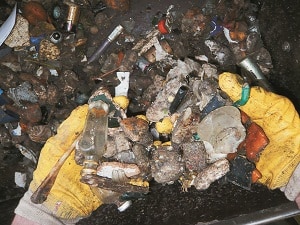
Sorting equipment manufacturer TiTech has called on companies developing anaerobic digestion facilities to do more to address the issue of feedstock contamination from inert materials such as glass and plastics.
The company claimed that, while separate collections of food waste help to address the issue, there can still be packaging mixed in with organic waste, which, if allowed to enter AD systems, can cause serious damage and compromise the productivity of the AD process. TiTech cited experiences at a materials recycling facility in Spain which it said proved that inert contamination in feedstock was costing AD companies time and money, and, as a result, called for AD operators to invest in sorting systems to target inert materials in the waste stream before it enter the digestion process.
Jonathan Clarke, managing director of TiTech UK, said: The UK is putting a lot of emphasis on AD as a means of treating organic waste and generating renewable energy. Its a great technology with a lot of potential: but in order to deliver optimum results, the infeed material needs to be as pure as possible.
EA introduces four new standards rules sets for waste
New rules which aim to reduce the administrative burden on four waste management activities by allowing them to be covered by a cheaper and simpler form of environmental permitting have been published today (April 6) by the Environment Agency.
The standard rules sets, which apply to composting, metal recycling, vehicle storage, depollution and dismantling and to the treatment of waste wood for recycling, have been published alongside revised sets of existing standard rules for another nine waste management activities. If operators are not able to meet the requirements set by the standard rules then they are required to apply for a more expensive and complex bespoke environmental permit.
Details of the new standard rules include: for composting biodegradable waste in open and contained systems, SR2011 No. 1, can be found here; for metals recycling, SR2011 No. 2 can be found here they relate to smaller-scale activities than the existing SR2008 No.21, and are expected to be used by sites who previously operated under the now-defunct Paragraph 45 exemption; for vehicle storage, depollution and dismantling at an authorised treatment facility can be found here and also relate to smaller-scale operations, with a permit consequently costing less than for a larger site; for the treatment of waste wood for recovery, SR2011 No.4 are located here.
Veolia begins gas platform dismantling project
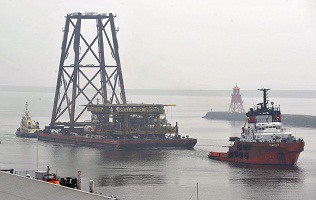
Veolia Environmental Services has begun its part in the decommissioning of North Sea offshore gas platforms at the former Swan Hunter shipyard on the River Tyne.
The process, which officially got under way last week (April 1), involved the company working with its offshore decommissioning partner, logistics company Peterson SBS, to dismantle the steel structures. The first platform being dismantled is 17 storeys high and arrived at the historic former ship-yard, which is now owned by North Tyneside council, on a barge from Shell UKs Indefatigable gas field, located 75 kilometres off-shore in the Southern North Sea. The barge is the first of eight scheduled to arrive at Swan Hunter over the next four months.
In a statement, Veolia ES said: It is planned to safely decommission 10,500 tonnes of redundant gas platform parts from April to October this year with a target recycling rate of 98%. The work is set to directly create 35 jobs and contribute at least a million pounds to the local economy.

Register for free to comment