


Sims plastics recycling centre to boost ELV recovery

The Billingham facility is being set up following trials of advanced polymer recycling at the companys WEEE recycling plant in Newport, and is currently in the commissioning stage. The company expects the plant to be fully operational in the coming months.
The announcement of the advanced polymer recovery facility comes as Sims said it had exceeded the governments target of 85% recovery from ELVs using automotive shredder residue technology.
Current reporting protocols set by the Department for Business Innovation and Skills (BIS) allow an Authorised Treatment Facility to achieve 81% recovery from full depollution and basic recycling such as battery and tyre removal.
Sims Metal Managements group business development manager, Simon Palmer, said: The 41kgs figure is a milestone within the car recycling industry, meaning that Sims and our suppliers can demonstrate recovery of materials from vehicle recycling in excess of 85%.
We are particularly pleased that thanks to the tremendous efforts of our engineering team, we are the first ELV recycler in the UK to achieve this target through end to end in- house processing and to offer it free of charge to our suppliers.
With improving technology and the opening of our new advanced plastics recycling centre on Teesside, we expect to recover even greater quantities of metals, plastics and other residual materials in an effort to meet and indeed surpass future reporting targets.
End-of-waste guidance could cause problems
The European Commissions guidance on end-of-waste, as set out in the Waste Framework Directive, could cause problems for paper recyclers and risk the integrity of recycling systems according to the Confederation of European Paper Industries (CEPI).
End of Waste criteria specify when certain waste ceases to be waste and obtains the status of a product or a secondary raw material.
The ECs guidance states that if a reprocessing facility receives only material certified as fulfilling end of waste criteria, its activity is not a recycling or a recovery process, but instead a production process involving non-waste secondary raw materials.
CEPI state that these measures pose a serious risk to advancing a recycling society in Europe due to the fact that end of waste is described as equivalent to recycling, with waste management companies becoming legally responsible for output material as producers which could raise liability issues with the quality of waste material and its contamination.
And, according to CEPI, considering end of waste as equal to recycling will break the information flow for public authorities, which could have consequences for enforcing environmental law as well as producing reliable data and statistics.
CEPI argues that the Commissions approach could increase the risk of paper mills receiving low quality material from collectors.
Preston WEEE recycler gets DCF status
Preston-based WEEE and metal recycler and social welfare charity Recycling Lives has officially registered its Essex Street site as a designated collection facility (DCF) for waste electrical and electronic equipment (WEEE).
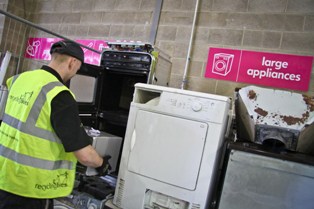
As a DCF the site will be dedicated to the collection of WEEE from residents for recycling.
The company is also planning to seek DCF status for its other sites in the area, in response to the closure of four of Lancashires Household Waste Recycling Centres (HWRCs)
Householders can now deposit waste electricals including large and small domestic appliances, gas discharge lamps, cooling equipment and portable batteries at the Essex Road site free of charge.
All of the materials collected are able to be processed at one of Recycling Lives AATFs (Approved Authorised Treatment Facilities).
SEPA consultation on AD technical guidance
The Scottish Environmental Protection Agency (SEPA) has launched a consultation on technical guidance for anaerobic digestion (AD).
SEPA is seeking comments from the AD industry on the guidance, which is set to be used by inspectors when considering all aspects of regulation of sites involved in AD. The consultation will run until July 27.
The consultation covers permitting and licensing considerations, waste acceptance and biomass performance, odour abatement and bio-aerosols, containment, modelling and impact assessment and hierarchy of biogas use.
Medway school pupils collect 24 tonnes of WEEE
More than 12,000 school pupils in Medway took part in a week long WEEE project to raise awareness of how to correctly dispose of waste electronic equipment.

A total of 33 schools took part in the event organised by Medway council, WEEE reprocessor SWEEEP and Veolia Environmental Services.
Each school was provided with a pink skip for one week, where small WEEE items such as computers, mobile phones and kettles could be collection. In total more than 24 tonnes of WEEE have been collected.
Featherby Infant and Nursery School and Silverbank Park came tied first in the competition to collect the most WEEE, managing 9.88kg each per student. Both schools will receive 500 from Veolia and a tour of the SWEEEP facility in Sittingbourne, Kent, where all collected materials are recycled.
Medway councils portfolio holder for community services, Councillor Phil Filmer, said: Id like to congratulate the winning schools for their excellent efforts. This project is the first of its kind in the south east and I hope it will help us to continue to raise awareness among all ages about the importance of disposing of electronic waste responsibly.
Manager of SWEEEP Kuusakoski Justin Greenaway added: Every school involved with this needs a pat on the back as their enthusiasm has been terrific. The raw materials from waste electronics are a valued commodity containing numerous rare earth metals. Diverting 24 tonnes of waste that could otherwise have gone to landfill is to be commended.


Register for free to comment