



M&S teams up with UNICEF for hanger recycling initiative
Under the scheme, the retailer said that 50p out of every 1 saved when the retailer recycles or reuses coat hangers will be donated to the childrens organisation. The initiative aims to raise at least 1.9 million over the next few years, with the money going to find a new project within the Mymensingh and Dhaka regions of Bangladesh. Specifically, the funding will provide basics such as clean water, education and healthcare for children. The scheme is being fronted by TV presenter Cat Deeley, who is a UNICEF ambassador.
David Bull, executive director of UNICEF UK, said: UNICEF is extremely excited about our ground breaking new partnership with M&S. Support from such a trusted high street retailer as M&S, as well as its millions of customers, will enable UNICEF to transform the lives of 50,000 people, giving children the best possible start in life.
The hanger recycling comes under the M&S “Plan A” environmental scheme hanger which allows the retailer to re-use and recycle over 150 million unwanted hangers a year.With this new campaign, M&S is aiming to add another 50 million hangers a year to the scheme, raising even more money for UNICEF and further reducing the environmental impact. Last year the hanger recycling programme saved 15,000 tonnes of carbon dioxide.
Palm roles out dual stream recycling banks in Hull
Palm Recycling has introduced changes to the community bring bank system in Hull which it claims will make the banks easier and more cost-effective to manage, as well as delivering environmental benefits.
Working under contract for Hull city council, the recycling company has replaced individual banks with: mixed fibre banks – taking both paper and cardboard; mixed container banks – taking plastics, glass bottles and cans; and a separate bank for textiles. According to Palm, this approach reduces the number of banks required on-site while encouraging greater recycling with Hull residents now able to recycle a far greater range of materials. With fewer sites and mixed materials, the number of collections and vehicle miles is reduced, delivering a significant CO2 and fuel-cost saving said the company.
Ross Johnstone, business manager at Palm Recycling, said: We worked closely with Hull city council to ensure that the need to reduce the number of sites and collections did not impact on recycling rates and the bank management system we have established ensures this. Its a good system for every one; it saves money, increases recycling rates and delivers measurable environmental benefits too. Even the banks we have installed are more aesthetically pleasing, which is important for local community acceptance.
Caption:
Palm Recycling has introduced a new dual-stream system for community bring sites in Hull
Planning framework for EfW overcomes final hurdle
New guidelines that aim to speed up the planning process for large-scale renewable energy infrastructure, such as energy-from-waste facilities, have been finalised, after being designated by ministers.
The National Policy Statement for Energy, and a more specific document for Renewable Energy, will set the framework to be used by the independent Infrastructure Planning Commission when deciding on planning applications for EfW facilities with a capacity of more than 50 megawatts. When the IPC is abolished, that role will pass to a new Major Infrastructure Unit to be created within the Planning Inspectorate. The decision to finalise the NPS this week (July 19) followed a House of Commons debate on the statements on Monday (see letsrecycle.com story). Two EfW projects are currently lined up to be considered under the NPS guidelines, both of which are proposed by Covanta Energy.
Commenting on the role the NPS will play, Charles Hendry, minister for energy, said: Far too often the planning system has resulted in delay and indecision over major energy projects and things simply not getting built. We are removing uncertainty to give industry the confidence to invest in much-needed new energy infrastructure in this country.
Envac lays pipes for Brent to Wembley link
Underground vacuum waste management company Envac has begun laying pipes that will link the new Brent Civic Centre to its existing Wembley City vacuum waste infrastructure.
Envac manages the entire waste output of Wembley Citys flagship residential developments, but the new installation means it will also be responsible for handling waster waste from an additional 4,2000 mixed-use residential units as well as from 2,000 Brent council employees. It also covers the Hilton Hotel and the new London Designer Outlet, representing an area spanning 40,000 square metres when the building is completed in 2014.
Julian Gaylor, Envac UKs managing director, said: Today represents a key milestone in the on-going regeneration of Wembley City and the relative ease at which waste vacuum technology can be incorporated into neighbouring developments. Just like a puzzle, buildings and even entire boroughs can be connected up to the Envac system, which handles in ten minutes what multiple waste collection vehicles take all day to do. Waste collections can also be made hourly, if required, as opposed to weekly or even fortnightly.
ENER-G helps get poultry farm AD project off the ground
Manchester-based renewable energy company ENER-G played a key role in helping an on-farm anaerobic digestion project in Hereford to get up-and-running.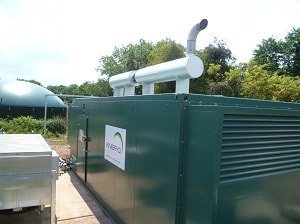
The company was contracted alongside biogas plant manufacturer PlanET Biogastechnik to deliver an AD system that would convert chicken litter and other farm waste material at Great Ynys Farm into biogas for renewable electricity and heat generation. The AD facility will have capacity to process 700 tonnes of poultry litter and 1000 tonnes of cattle slurry, mixed with 3000 tonnes of maize silage per annum. The plant will produce 250 kilowatts of electricity and 250 kilowatts of heat.
The farms owners set up a new subsidiary, Ynergy, to oversee the project, and Susan Shakesheff, director of Ynergy Ltd, said We are proud to be at the forefront of the move to anaerobic digestion, and to improve our sustainability, and energy self sufficiency, while securing a new income stream. We are able to find a superior alternative for utilising our chicken litter and are helping neighbouring dairy farmers to recycle their cattle slurry.

Register for free to comment