


City of London launches light bulb recycling scheme
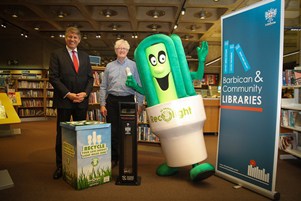
The scheme will see 11 containers deposited at eight locations across the Square Mile of the City where low energy light bulbs can be recycled by residents and workers in the region. The bulbs will then be collected for recycling by Recolight.
A battery recycling scheme has also been launched in conjunction with battery recycling scheme ERP.
Recolights customer service manager, Lyndsey Smith, said: This is an important and exciting partnership which will open up vital new channels for the public to recycle their old low energy light-bulbs. People want to recycle their old bulbs but are often unsure of where the nearest facilities are. These containers will be visible to hundreds of consumers every week, and we hope that this will help make a difference to recycling in the local area.
Plans submitted for 8 million Dorset waste centre
A planning application for an 8 million waste management centre has been submitted by the Dorset Waste Partnership to the Dorset county council planning committee.
The application is for a combined household waste and recycling centre (HWRC) and waste transfer station at Broomhills, near Bridport. The proposed new site will replace the existing Bridport facility which the DWP said is restricted in terms of its size, opening times and materials. The new facility will be able to accept more types of material such as wood and glass and return to full weekend opening times.
It is hoped the outcome of the application will be determined on July 26 with construction to start in August. The DWP said it is aiming for the site to be completed in spring 2015 in time to support the planned introduction of the new recycle for Dorset collection service (see letsrecycle.com story).
Hilary Cox, chair of the DWP joint committee, said: Local people have been following the search for a new waste management centre for Bridport over many years and will, Im sure, be relieved to see it nearing a conclusion. A modern facility has been designed to help meet the needs of the local area and increase our recycling while blending in with the outstanding local environment.
INCPEN launches The Good, the Bad and the Spudly campaign
The Good, the Bad and the Spudly campaign has been launched by the Industry Council for research on Packaging and the Environment (INCPEN) as it aims to highlight the important role packaging plays in reducing food waste.
SEE THE VIDEO AT:

INCPEN is a non-profit research organisation which is dedicated to analysing and minimising the environmental impact of packaging. Its members include companies from throughout the packaging supply chain.
Jane Bickerstaffe director of INCPEN said: There is so much in the press these days about what a waste packaging is, we decided that it was about time someone gave the other side of the argument. We want the public to have all the facts. Should we buy loose bananas or ones in a bag?
“Well, its up to you, but remember bananas bought and stored in a bag will last days longer, so theres less chance of having to throw them away.
For more information, contact: Incpen.
Repic achieves ISO 14001 accreditation
WEEE compliance scheme Repic has achieved the ISO 14001 environmental management accreditation which marks the companys efforts in reducing its environmental impact.
The ISO 14001, which Repic gained following an independent assessment, outlines a set of standards for organisations to adhere to in order to design and implement an effective environmental management system. It includes guidance on areas including improving efficiency and waste reduction, reducing risk and environmental liabilities, and improving health and safety conditions for employees and communities.
Dr Philip Morton, chief executive at Repic, said: Achieving the accreditation further demonstrates our commitment to the environment, our members, the local authorities we work with and other collection and treatment partners. It is almost ten years since Repic was established and back then, we set ourselves a goal to provide maximum cost-effective compliance for our members, consistent with excellent environmental performance. This still remains our priority and this is another step on our continuing journey to constantly improve the service we offer the many organisations with which we work.
CEWEP welcomes EU move to end landfilling of plastic
A European Commission green paper outlining plans to end the landfilling of plastic waste has been welcomed by the Confederation of European Waste-to-Energy Plants (CEWEP).
.jpg)
The green paper on plastic waste was published in March 2013 (see letsrecycle.com story) with the aim of sparking debate around a possible ban on landfilling plastic, although the Commission is keen to see any ban carried out in line with the waste hierarchy.
In a statement responding to the paper, CEWEP called for plastic waste to be dealt with higher up the hierarchy and for quality standards to be developed for plastic recycling based on environmental and economic criteria.
Plastic waste not suitable for recycling, meanwhile, should be treated in energy-from-waste plants to produce electricity and heat in order to help reduce Europes high dependence on imports of fossil fuels, according to CEWEP.
Furthermore, CEWEP said additional taxes on energy production would be counterproductive and would not help to achieve quality recycling as there is no competition between quality recycling and energy recovery for waste.
Taxes would only make local energy production more expensive for citizens and industry without providing any additional environmental benefit, the CEWEP statement said. There is no technical, environmental and certainly no economic reason to limit energy recovery of plastics wastes that are not suitable for quality recycling.

Register for free to comment