



Nappy recycling specialist Knowaste is seeking a location in the South East to build a facility to process absorbent hygiene products (AHP), after closing its first plant in the West Midlands last year.
Knowaste opted to shut down the 36,000 tonnes per year capacity West Bromwich plant in May 2013, claiming that it had outgrown the site (see letsrecycle.com story).
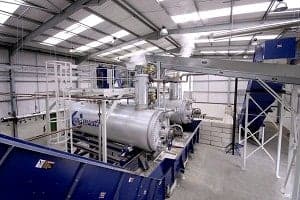
Now, the company has announced that it is seeking premises close to Oxford, Luton or London with access to sustainable heat, power and water sources, with sites in close proximity to existing energy from waste, biomass, anaerobic digestion or water treatment facilities being favoured.
Knowaste intends to have secured a location for its new site by March this year, which it hopes to have operational by mid 2015. The company also says it has already secured supply agreements for the supply of material to the plant from local authorities and commercial clients.
Access to an affordable energy source is thought to be crucial to the viability of the plant, with high energy costs due to the energy-intensive nature of the AHP recycling process among the factors leading to the closure of the West Bromwich facility.
Development
But, Knowaste has also stated that although the West Midlands site allowed it to prove and further develop its technology; there was not adequate capacity for the company to maximise the market opportunities that it had identified for the materials generated from the recycling process.
We want to find an optimal site close to sources of sustainable heat, power and water that is also optimally located for us to meet the demands of local authorities and hygiene companies.
Paul Richardson, Knowaste
Paul Richardson, business development director at Knowaste, said: The location of the new facility is critical. We want to find an optimal site close to sources of sustainable heat, power and water that is also optimally located for us to meet the demands of local authorities and hygiene companies.
Knowastes West Bromwich facility opened in September 2011, with Cardiff city and Monmouthshire county councils among the first to sign up to send disposable nappies to the site for recycling (see letsrecycle.com story) as well as Cheshire West and Chester council.
The site also received material from commercial waste operators including PHS, OCS and Initial.
Absorbent hygiene products (AHP) received at the plant were treated using autoclave technology to sterilise the material. It was then sorted to recover the plastic and fibre material which was used in the production of new products.
Knowaste says that any new plant will also comprise washing, separation and drying processes, as well as a plastic pelletiser.
Envirocomp
Since the closure of the West Bromwich plant, organics recycling firm Envirocomp has opened a facility in Rochester, Kent which is capable of treating nappies and other sanitary products through a composting process (see letsrecycle.com story).
Related Links
Mr Richardson commented that although the two firms would be competing for feedstock, the competition would be healthy for both businesses.
He said: I think that competition is always good and we both have our own areas of expertise. We operate on a larger scale but we are also looking at smaller scale plants as part of our expansion.

Register for free to comment