


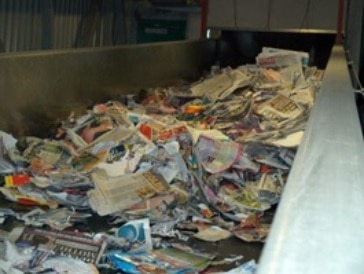
Mixed papers, primarily sourced from the household waste stream by local authorities through waste and recycling contractors, have always contained an element of packaging ranging from cereal boxes to cardboard.
Accordingly, in the early stages of the PRN system it was agreed that 12.5% of mixed papers could count as packaging material and so for every eight tonnes handled one PRN – a packaging waste recovery note – could be generated.
It now appears that the Department for Environment, Food and Rural Affairs is close to agreeing on a 23% figure for packaging in mixed papers following trials at a materials recycling facility operated by Viridor. However, the 23% figure could be approved by Defra and the Environment Agency as just an interim measure ahead of further trials within the recovered paper sector.
Volume
If approved, the new figure would be a boost to UK mills as they could issue more PRNs. This is becoming more important as cardboard manufacturers in the UK are using high volumes of mixed papers in their cardboard mix. Traditionally about 10-15% might have been used and now some mills are said to be looking to use 30-40% of mixed papers to produce new cardboard.
However, one limitation on the use of mixed papers arises because of a general move to lightweighting of cardboard boxes. The fibres found in mixed papers are generally shorter and so not so strong as fibres found in used cardboard and with a need for lightweight cardboard boxes to retain strength, there is something of a trade-off between reducing the cost of production through using more mixed paper and then not having a strong enough product.
Simon Weston, director of raw materials at the Confederation of Paper Industries, said: “While the 23% figure is still to be finalised, I think it is a very positive move to align the amount of paper packaging within mixed papers and the PRN system. The existing protocol has been in existence since early in the PRN regime and consumer buying habits have changed.”
“I think it is a very positive move to align the amount of paper packaging within mixed papers and the PRN system.”
Simon Weston
CPI

Partnership
Also involved in the discussions with Defra over the move to a higher packaging rate has been the Recycling Association. Its chief executive, Simon Ellin, told letsrecycle.com that he thought the work towards achieving agreement on a higher rate “was an excellent example of a partnership approach between industry and government”.
He said: “Credit to Defra that they recognise there is a case here. This shows how we can all work together to improve things. What we have seen is what constitutes mixed paper has changed out of all recognition. Mixed paper has been getting harder and harder because of the increase of packaging in the grade.”
And, Mr Ellin added: “My gut feeling is that once we carry out more research, we will find the packaging volume is considerably higher than 23%.”

Register for free to comment