

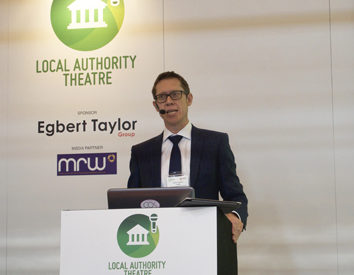
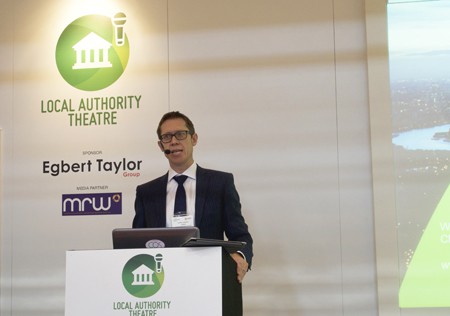
Speaking during day one of the conference and exhibition at Birmingham’s NEC Mr Hubbard presented his keynote address: ‘Making savings and creating revenue – London’s circular economy vision to Local Authority services’ on the Local Authority Theatre.
London
Mr Hubbard said that with an ever-growing population— estimated to be 10 million by 2030 — London will need to look ‘seriously’ at the waste implications of that growth.
According to Mr Hubbard, LWARB has predicted that by 2050 the waste infrastructure needs of the capital will be vastly different from the present day, especially if the city has transitioned to a ‘circular economy’ system.
Mr Hubbard suggested that this is likely to involve a drastic cut in the amount of waste produced. “It won’t be disposal and there won’t be so much waste. We still have that view,” Mr Hubbard said.
Mr Hubbard said he disagreed the circular economy is about ‘reduce, reuse, recycle’ or waste minimisation, rather he claimed it is about consuming differently.
Business models
In research carried out by LWARB into development of a “circular economy routemap,” the organisation has focussed on a set of key sectors and strategies, summarised in five circular economy business models, namely recycling, recovery, extending product life, the sharing economy and products as services. These models, Mr Hubbard said, “sum up the circular economy.”
“Cities are the engine of the circular economy,” Mr Hubbard said, adding that London has some “key strengths” when it comes to implementing these models.
Mr Hubbard also emphasised LWARB’s role in working with businesses and the public sector to explore ways to deploy these circular economy business models and commercialise them, claiming that the primary goal is to generate income for local authorities.
He added that LWARB would like to support SMEs to implement circular economy models from start-up to maturity.
Commenting on the need for policies to facilitate this transition, Mr Hubbard said: “Regulation of course helps, but there is a debate in the circular economy as to whether it is regulation led or business-led. It has been business led to date.” He added that this is a move “we can all take part in.”

Register for free to comment