
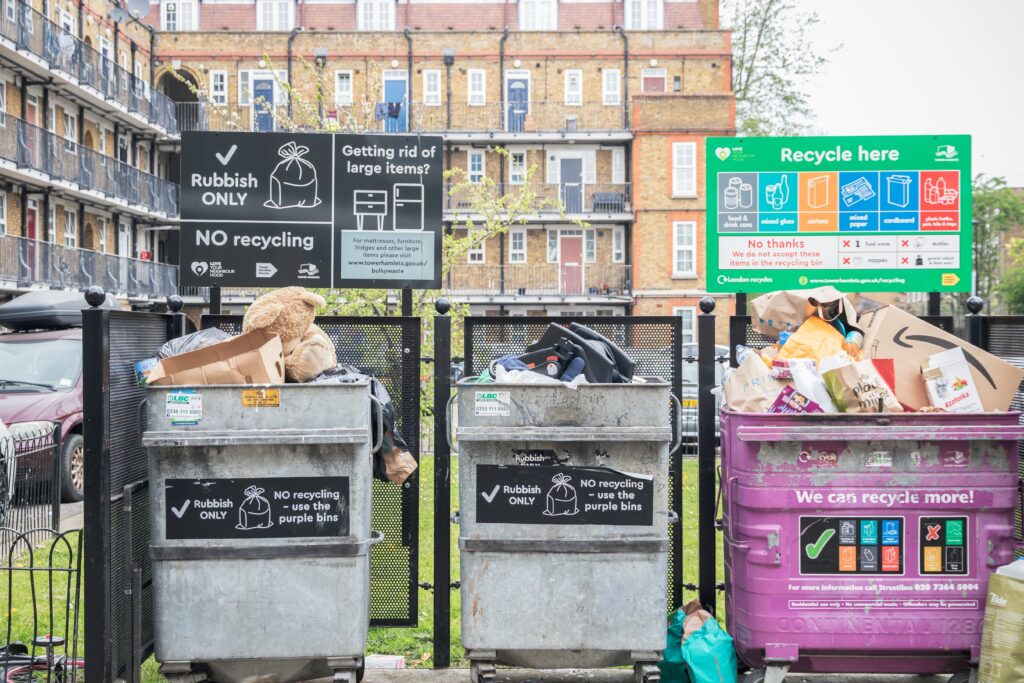
From 31 March 2026 local authorities in England must collect food and garden waste, paper/card, and dry recyclables from all households (including flats) unless a transitional arrangement applies.
For rental flats this means councils must work with managing agents and landlords to ensure that additional services and infrastructure (such as food-waste caddies, communal food bins, proper signage) are introduced and accessible.
Under Section 46 of the Environmental Protection Act 1990 (EPA 1990), councils can require the occupier of a property to present waste in “receptacles of a kind and number specified”.
But, in purpose-built blocks of flats, residents often don’t control what bins are available, the asset owner or managing agent does.
Peter Jones, Managing Consultant at Eunomia, explained: “There is no clear power for councils to require managing agents to accommodate the bins needed for a food collection service.”
Eunomia warned that this creates “an effective veto” on implementing Simpler Recycling in these contexts.
Why managing agents resist change
Eunomia identified several common rationales for why managing agents might resist Simpler Recycling changes:
- Space constraints in bin-stores: many blocks weren’t designed for multiple streams
- Concerns about odour, pests or contamination if food bins are introduced
- High turnover of residents and poor behaviour in communal properties making additional services harder to manage
- The managing agent may not see the direct financial benefit of installing extra containers or doing engagement
Because the statutory enforcement is aimed at occupiers and not the bin infrastructure decision-maker (the managing agent), councils can sometimes audit or penalise residents for non-compliance.
But when the resident has no control over whether a food‐waste bin exists, such enforcement ‘“is politically unattractive and legally dubious’“.
Jones added: “This problem has already emerged in some areas, and could be significant for urban authorities with high-density private housing stock.
“Areas with many privately managed flats could find themselves unable to deliver full food waste coverage, undermining the Government’s objectives.
“Can food waste collection truly be considered “mandatory” if a significant number of homes are structurally excluded?”
Councils warn of barriers ahead of 2026 deadline
Councils are already raising alarm bells about how food waste rollout in flats will play out.
In 2024, the Local Government Association (LGA) warned that some councils have experienced problems in blocks of flats where managing agents have refused to allow food waste collection from their buildings.
Without a fix, the imminent 31 March 2026 target for food-waste collections may be undermined.
Jones explained: “If Simpler Recycling is to live up to its promise, Defra needs to address this policy gap.
“A small amendment to the Environmental Protection Act to provide an enforcement route against managing agents would be one option, but because this is primary legislation it can’t be achieved through a statutory instrument.
“In the absence of this, the Government could provide advice or even funding to help address misconceptions and improve bin storage to reduce resistance.
“Until this happens, councils are left in the impossible position of having a duty to provide universal collections when they lack the power to make this a reality.”
With concerns already rising over the level of compliance from business regulations that came into effect on 31 March 2025, the exclusion of residents in flats risks undermining more of the ambition of Simpler Recycling.

Register for free to comment