


The Liberal Democrat party should include legally-binding business waste targets and a review of business waste definitions in its 2015 election manifesto, according to policy proposals put forward by a group of the partys MPs and activists today (March 11).
In addition, the party should seek to establish a single environment department in government to champion policies for sustainability and give as much infrastructure and investment power as possible to combined authorities in metropolitan areas such as London.

The authors of the 40-page Geen Manifesto: How to increase living standards, improve quality of life and future-proof the economy which include Fiona Hall MEP, Martin Horwood MP, Julian Huppert MP say that their wish-list of proposals for the Lib Dem 2015 election manifesto amount to a war on waste.
Among its policies, the documents calls for the Lib Dems to regulate against the incineration of non-recyclable waste and argue for the faster development of EU sustainable design and production standards.
And, through the Waste and Resources Action Programme (WRAP) and the Environment Agency, the party should review waste definitions and product specification and also introduce binding packaging reduction targets and better enforcement of the excess packaging regulations, the documents argues.
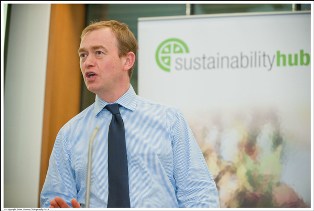
‘The Green Manifesto shows us how we need to build a green economy, because if the economuy is not green it will be neither competitive nor successful. I wholeheartedly support its case that the green approach must lie at the core of the Liberal Democrat appeal at the 2015 election.’
Lib Dem party president Tim Farron MP
With regards to taxation, the document states that the Lib Dems should maintain the landfill tax, implement annual increases in the aggregates tax and also commission the Natural Capital Committee to investigate the potential for other resource taxes, variable waste charging for households, and deposit-refund schemes.
Also among suggested waste and resource efficiency policy proposals outlined in the document are new EU standards for products, appliances and vehicles; a ban on dumping non-recyclable wastes; and the commissioning of a detailed government blueprint report to look at reducing the UKs consumption of natural resources.
Investment
The group of MPs and activists state that the Lib Dems should also draw up a strategic infrastructure plan, giving associated funding and regulatory powers to the Green Investment Bank (GIB).
Furthermore, the party should allow the Green Investment BanGIB to raise finance, including enabling it to issue green bonds for retail savers. It would also expand the GIBs remit to include domestic energy efficiency and community energy.
Energy
By 2030, the documents states that the party should aim for 50% of the UKs electricity generation to come from renewable sources by 2030, with the UKs energy coming from entirely sustainable sources by 2050.
Towards this aim, the green manifesto puts forward a preference for the use of biomass for heating rather than electricity generation. And, for local and small-scale uses, the group say the party should provide financial support and regulatory reform to encourage the wider use of biogas, particularly from anaerobic digestion and especially where it is injected into the gas network.
The Lib Dems Green Manifesto was written by: David Boyle, Duncan Brack, Paul Burall, Fiona Hall MEP, Martin Horwood MP, Julian Huppert MP, Baroness Parminter, Neil Stockley and Mike Tuffrey.
Related Links
However, the manifesto states that not every contributor necessarily agrees with every proposal in this paper.
The manifesto states: We believe that the Liberal Democrats are uniquely placed to pursue the programme outlined in The Green Manifesto. Liberalism is an intrinsically green political philosophy; the green approach comes more naturally to us than it does to either the Conservatives or Labour.
Lib Dem MP and party president, Tim Farron MP, said: The Green Manifesto shows us how we need to build a green economy, because if the economuy is not green it will be neither competitive nor successful. I wholeheartedly support its case that the green approach must lie at the core of the Liberal Democrat appeal at the 2015 election.


Register for free to comment