

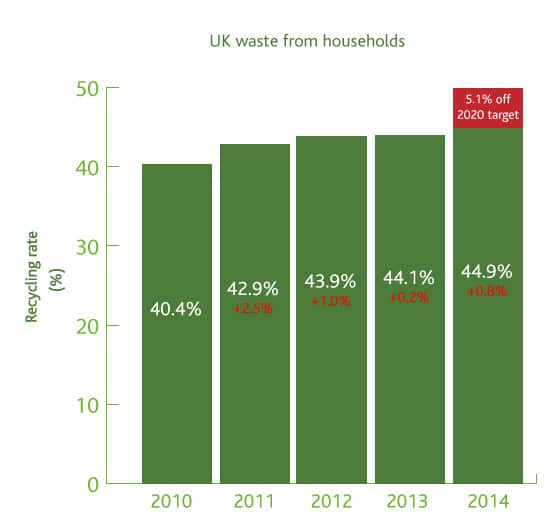
This represents an improvement of 0.8% when compared to 2013, but it confirms that the UK is currently making slow progress towards the 50% by 2020 recycling target set out in the EU’s Waste Framework Directive.
In its statistical release on the figures, the Department for Environment, Food & Rural Affairs (Defra) said: “The UK recycling rate of ‘waste from households’ reached 44.9% in 2014, rising from 44.1% in 2013 and compares to 40.4% in 2010. There is an EU target for the UK to recycle at least 50% of household waste by 2020.”
 The data which has been submitted to the European Commission ahead of a summer 2016 deadline, brings together the overall recycling figures for England, Wales, Northern Ireland and Scotland – demonstrating the disparity in performance between the home nations.
Wales continues to lead the way with an overall rate of 54.8% for the year, compared to England’s 44.8%, 43.6% in Northern Ireland and Scotland’s 41%.
However, Wales’ positive performance will not be sufficient to drag the UK towards its overall 50% goal, with the 705,000 tonnes recorded as recycled in the province dwarfed by the 10,025,000 tonnes collected for recycling in England. The data suggests that significant improvements in English recycling rates, or changes in methodology, will be required if the UK is to avoid EU fines for missing its 2020 target.
‘Stagnating’
Many in the waste sector have long argued that recycling rates in the UK are stagnating, a claim supported by the latest figures. Recycling figures published for the financial year 2014/15 for England also suggest that there is unlikely to be a significant surge in progress towards the 2020 target, with a total of 44.7% collected for recycling for the financial year, an increase of just 0.2% on the preceding 12 months.
The challenge is only likely to get harder for the UK with the European Commission setting out proposals for a 65% municipal waste recycling target by 2030 in its latest Circular Economy package. And, while this target is still to be formally adopted as a legally binding measure within the Union, some MEPs have outlined their desire to see this aim increased to 70% in line with more ambitious proposals put forward by the former Environment Commissioner Janez Potocnik in 2014. Already there is talk in the Commission of a review in 2025 with the aim of a 70% figure for 2030.
Biodegradable waste
Other features of today’s data include figures showing that UK Biodegradable Municipal Waste (BMW) sent to landfill has continued to reduce and totalled 9.2 million tonnes in 2013. This indicates that the UK comfortably met its landfill reduction target for the year to send no greater than 50% of total volume of waste landfilled in 1995 to ground by 2013. In total, the figures confirm that the UK landfilled 23% of the 1995 total.
At present there is no overall UK BMW figure available for 2014, with figures still to be submitted by the Welsh Government. However, Defra expects that the full figures for BMW to landfill will be published by summer 2016, and that all of the home nations will publish their figures for 2015 in the winter.

Register for free to comment