

The council’s Waste Minimisation Strategy 2015-2020 aims to build on progress in the Berkshire town, which achieved an overall recycling, composting and reuse rate of 35% in 2013/14.
Throughout the year 59,134 tonnes of waste was collected by the council from the kerbside – a figure which is expected to rise in the future as the town’s population continues to increase.
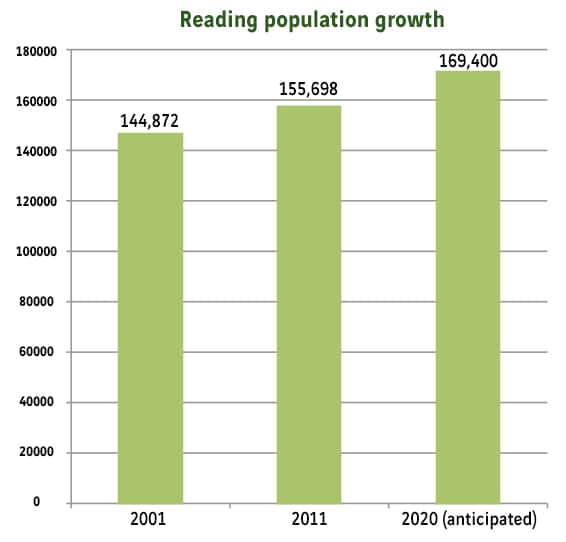
According to the council, Reading’s population now sits at just under 160,000, having grown by almost 20,000 since 2001. It is expected to reach 169,400 by 2020.
The plan outlines potential ways the council could achieve the 15% increase needed to comply with the mandatory 50% target that all local authorities in England must achieve over the next five years.
Communications
These include a ‘better and more effective’ communications campaign aimed at informing residents which materials can be placed in their red recycling bins and black residual waste bins, as well as looking at the number of ‘on-the-go’ recycling sites and bins in the town.
The council would also stage a review in the first year of the strategy determining how food waste recycling can be improved.
Reading currently operates a fortnightly service for residual waste and commingled recycling collections. Residents can opt-in to garden waste collections by purchasing a green wheelie bin or bag.
Residents are being asked to comment on the strategy by February 20, via an online consultation available on the council website. Comments will then be reviewed before the strategy returns to a meeting of the Housing, Neighbourhoods and Leisure Committee in the spring for discussion.
Liz Terry, the council’s lead member for neighbourhoods, explained that Reading’s rapidly increasing population would throw up new challenges for waste and recycling in the immediate future.
She added: “This draft Waste Minimisation Strategy outlines how we hope to achieve that, by combining better public information with some important practical steps to help increase recycling rates. Landfill charges continue to rise and at the time of hugely restricted resources for Local Government, that cannot continue.
“Reading is this year moving towards a much more targeted approach where it will focus resources on neighbourhoods. Every neighbourhood in the town has its own challenges in terms of waste collection. By focusing on individual communities, we aim to tackle those challenges head-on.”
The draft strategy has been developed under the umbrella of the ‘re3’ joint waste partnership between Reading, Bracknell Forest and Wokingham borough councils, which was established in 1999.

Register for free to comment