

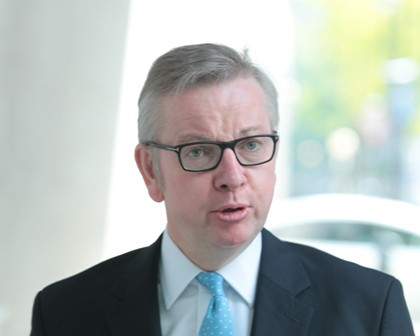
Appearing to suggest that the new body will replace the Agency, Mr Gove said yesterday (12 November), that there is to be a consultation on establishing “a new, world-leading body to give the environment a voice and hold the powerful to account, independent of government and able to speak its mind freely.

The new body will be on a “statutory footing” and its ambition will be to “champion and uphold environmental standards always rooted in rigorous scientific guidance.”
Powers
At present the Environment Agency has a large number of powers but when the UK leaves the European Union there had been little clarity so far as to who might take on powers such as ensuring councils meet recycling targets.
The Agency also used to have a strong ‘semi-political’ division which contributed to policy development and thinking but this has been weakened in recent years in the face of budget cuts.
Explaining his plans in the Sunday Telegraph yesterday, Mr Gove said that after Brexit: “We have the chance to set the gold standard for environmental science and become a home to centres of environmental excellence. A new independent, statutory body and a strong statement of prinnciples will ensure that outside the EU, we become the wolrd leading curator of the most precious asset of all: our planet.”
A consultation on the new body is expected early in the New Year and discussions are still to take place as to what role it might have in Wales, Scotland and Northern Ireland.
Radical
The secretary state’s comments come just weeks after resource and recycling minister Therese Coffey had said that the government’s 25 Year Environment Plan was being delayed until early next year, because Mr Gove wanted it to “more radical” than the version which had been drawn up.
Tomorrow MPs are to start debating the European Union (Withdrawal) Bill when it reaches Committee Stage in the House of Commons.
Amendments
Many amendments have been put forward on the need to strengthen environmental legislation and to protect the environment. An example is an amendement one put forward by Mary Creagh MP (Labour) who is chair of the Environmental Audit Committee.

Mrs Creagh is calling for: “Retention of principles of EU environmental law (1) On and after exit day the environmental principles of European Union law become principles of United Kingdom law in accordance with this section. (2) The “environmental principles of EU law” are the principles set out in Article 191 of the Treaty on the Functioning of the European Union (the precautionary principle; the principle that preventive action should be taken; the principle that environmental damage should as a priority be rectified at source and that the polluter should pay).
“(3) A court or tribunal interpreting or applying an enactment must, so far as it is possible to do so, construe or apply the enactment in a manner that is compatible with the environmental principles of EU law. (4) A public authority must, in the exercise of its functions, have regard to the environmental principles of EU law.” Member’s explanatory statement This new clause would ensure that after withdrawal from the EU, the environmental principles of EU law would be retained as part of UK law.”

Register for free to comment