

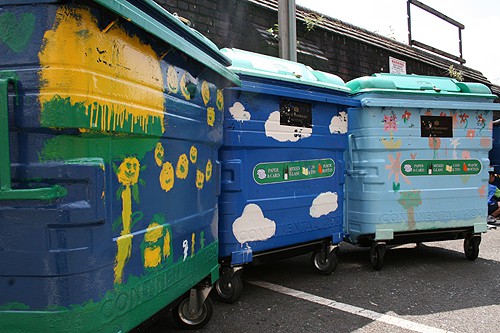

The comments came at a London Remade local authority network meeting on public place recycling, which followed the launch of a Defra drive to encourage recycling on the go (see letsrecycle.com story).
Delegates from London local authorities and the waste industry discussed the major issues faced by the capital in bridging the gap between public place and household recycling rates, with the main concerns raised over whether the desired content of recycling bins was obvious to members of the public.
Iconography
Opening the event, a Defra official said that unified implementation of Recycle Now's iconography would be important in letting people on the street know what they could recycle and where.
Tristan Crago, Defra policy adviser on local environment protection, said: “Brand recognition is very strong. Research shows that upwards of 75% of councils use the ‘Recycle Now' brand and 65% of consumers recognise it.”
Mr Crago was keen that councils made it as clear and simple as possible for people to recycle when they were out and about by having the right indicators in place. “You have to ask, is it easy for the public to understand that it is a recycling bin?” he added.
Contamination
Contamination is clearly going to be a big concern to anyone launching a scheme.
Tristan Crago, Defra
Concerns over the potential for contamination of on-street recycling bins – through lack of clear indication or public ignorance – were also raised at the event and findings were discussed from a case study carried out by London Remade and Sauce Consultancy at London's ExCel conference centre.
The study found a high quantity of ‘waxy card' (coffee cups and food packaging) had been deposited in recycling bins intended for paper and it was noted that food waste would present a risk to dry recyclables.
Tim Burns of Waste Watch, agreed that contamination could occur on-street and said that clear signs would be important in preventing it as much as possible, having seen the example of a recycling bin designated ‘food plates and cups' being filled with waste food along with plates and cups.
Mr Crago said: “Contamination is clearly going to be a big concern to anyone launching a scheme. Some research has said you can expect contamination as low as 2%. However, our consultation has led us to believe that the figure is more likely between 10-20% but over time it would drop.”
Listen
At the talk, the importance of local authorities being receptive to their area's specific needs was also highlighted and Keith Tyrer, customer services manager for bin designer, manufacturer and supplier Glasdon, stressed that councils needed to think carefully about what they wanted before buying bins.
Mr Tyrer explained the diverse options available to councils and showed images of the C-Thru bin, which was designed for use at the 2002 Commonwealth Games in Manchester.
The bin, conceived with anti-terrorism criteria in mind, was made of clear plastic and clearly highlighted what material the bin recycled. Touted merely as an example of suiting different needs, Mr Tyrer reiterated that clear signage was key.
He also claimed that on-street recycling could only be beneficial if the design suited its area and the public was clear about its intended content. He said, “We have to try and create designs to get the message across as forcefully as we can.”
London Remade project manager Andy Marsh echoed Mr Tyrer's sentiments. He said: “You've got to listen and put in place what the people want and are going to use.”
Westminster
Offering a specific viewpoint, Phil Robson, recycling manager for the City of Westminster, described the problem of free evening newspapers, which had led to four tonnes of additional waste paper entering the council's street cleansing waste stream.
The influx of waste paper into the area led to the borough having to invest in 50 extra Envirobanks in the busiest areas before a voluntary deal to create publisher responsibility was formed.
The deal, which isn't legally binding, has seen the publishers of London Lite and thelondonpaper given two zones of responsibility and liability for litter picking, daily collections from 70 newly purchased recycling bins and maintenance of these sites.
The move has seen on-street paper recycling rise to 930 tonnes in 2007-08, an increase of 266 tonnes on last year, but Mr Robson highlighted that over 1000 tonnes of free newspapers are still going to landfill and even more can be done to improve on-street recycling.


Register for free to comment