

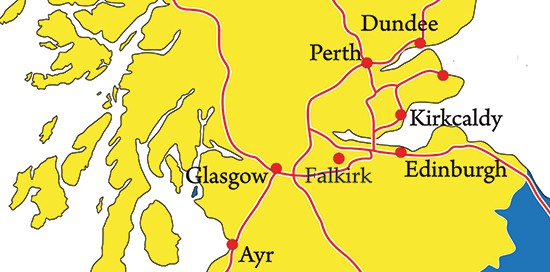
Collections of residual household waste in Falkirk are set to move from a fortnightly service to once every three weeks, under plans approved by councillors this week (December 11).
At a full meeting of Falkirk council yesterday, councillors were asked to consider a report on waste collection services, which found that a significant tonnage of recyclable material was going to landfill via waste collections.

In order to encourage recycling and reduce the tonnage sent to landfill, the report recommended decreasing the frequency of waste collections to either every three or four weeks, with councillors opting for three-week collections.
Falkirk council believes the move will save it up to 1.4 million a year in landfill tax costs.
The agreed changes follow findings in the report showing that as much as 60% 17,993 tonnes of the material in the household residual bins is actually recyclable, suggesting that current waste collection services are not being fully utilised by residents.
Under the current collection regime, the cost to the council of sending waste to landfill is set to rise from 2.3 million this year to 2.7 million in 2014/15.
The report describes Falkirk as one of the top performing councils in Scotland with a recycling rate of more than 50%, but under Zero Waste Scotland regulations the council must recycle 60% of household waste by 2020 and 70% of all wastes by 2025.
And, under the regulations, the council must send no more than 5% of material to landfill by 2025, on top of a ban on biodegradable waste to landfill by 2020.
‘The key finding from the composition of household waste was that a significant tonnage of recyclable material is still going to landfill’
Falkirk council report
Therefore, decreasing the frequency of residual collections, according to the council, will give residents a weekly collection capacity of 393 litres, which would save the council an estimated 258,826 in 2014/15 and 385,542 the following year.
Furthermore, the council estimates the change will result in a potential recycling rate of 60.8%.
The council moved to a fortnightly instead of weekly waste collection service in 2004, which the report claims boosted the councils recycling and composting rate from 6.4% in 2002/03 to 36% in 2007/08.
One of the first
Other councils in Scotland, such as Aberdeenshire, have previously discussed moving to three-weekly waste collections. Cardiff city council also recently consulted residents on a number of waste service options, including collecting residual waste every four weeks (see letsrecycle.com story).
However, a Falkirk council spokesman said he believed the town is one of the first in the UK to agree to implement such a regime.
The council spokesman said the changes would likely come into force from April next year, following an educational campaign to inform residents of how services will be affected. He added that he was confident residents would embrace the new collection regime in order to boost recycling.
Collection Conference: TEEP Joint Working and Vehicles
Organised by letsrecycle.com, the event takes place in Solihull on March 12.
The council report states: Repeatedly the residents of Falkirk have demonstrated an understanding of the importance of recycling, as demonstrated by our high standing in the recycling tables. On previous occasions they have adapted quickly to reduced green bin capacity, quickly finding, despite initial concerns, that it was indeed adequate. They have also adapted quickly to any new recycling services.
Recycling
Currently, the council operates an in-house fortnightly waste and recycling collection service on a rolling contract basis.
Related Links
However, recycling collections will not change under the waste collection proposals and, the report states, some properties such as high rise flats will not be part of this change.
Glass bottles and jars, small electrical items and batteries are collected in a kerbside black box, while mixed plastics, tetra pak cartons, cardboard and paper are collected in a blue wheeled bin.
A brown wheeled bin for garden waste also operates on a fortnightly basis and textiles are collected in sacks. An additional kitchen food waste caddy is also collected every week.

Register for free to comment