


A route map to help local authorities in England and Wales assess whether their collection arrangements meet the TEEP and quality requirements as set out in the revised Waste Framework Directive has been published today (April 22).
The document, which was developed by a working group comprising WRAP, LWARB and the Waste Network Chairs assisted by environmental consultancy Eunomia, provides a step by step process for councils to assess whether their collection services are compliant with the requirement for separate collections.
The regulations state that from January 2015 separate collections of at least paper, metal, plastic and glass are required where they are technically, environmentally and economically practicable (TEEP) and appropriate to meet the necessary quality standards for the relevant recycling sectors.
Councils have been left in the dark over what steps should be taken to ensure they comply with the regulations after Defra opted to scrap proposed guidance on the issue in January (see letsrecycle.com story).
The route map, which has also had input from the Waste Network Chairs, has been developed in response to the lack of statutory guidance and to reduce the need for individual local authorities to seek their own advice on the issue.
Chair of the working group, Lyn Carpenter, executive director for environment, leisure and residents services at the London borough of Hammersmith & Fulham, said: The Route Map prepared by local authorities for local authorities. It is a resource for local government and is not guidance. The Route Map gives local authorities the tools to make their own decision regarding their obligations under the Waste Regulations from January 2015.
It provides an approach that can be used by any local authority and should help individual authorities avoid reinventing the wheel in having to develop their own approach.
Process
The document outlines a six-stage process for local authorities to follow to ensure that they are compliant with the regulations – as well as links to additional information about following the process. It also outlines the need for local authorities to provide a clear audit trail to support any decision taken over services.
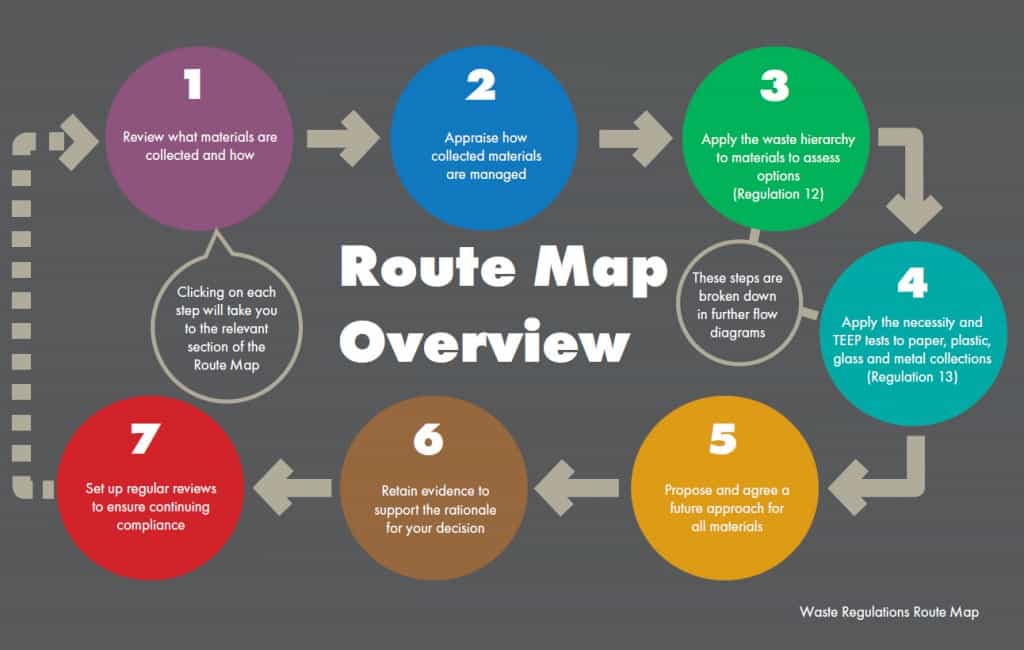
According to the route map councils should make reasonable estimates of the composition of waste that they are collecting as well as assessing which materials are currently collected separately and those that are collected commingled.

‘The Route Map provides useful information to help local authorities understand the requirements of the Waste Regulations.’
Linda Crichton, WRAP
The routemap recommends that data on how waste is collected should also be coupled with information on the recycling treatment and disposal of all waste streams with councils then required to assess how the material will be managed in line with the waste hierarchy.
Councils are then asked to assess whether there is a need to collect metal, glass, paper and plastic separately from one another, and to apply the tests over whether separate collections are necessary or practicable as set out in the regulations.
LWARB
Wayne Hubbard, chief operating officer of the London Waste and Recycling Board added: The London Waste and Recycling Board is delighted to have worked alongside the waste networks and WRAP in developing this Route Map. It is a critical tool for local authorities, particularly those in a dense urban environment such as London, where space for recycling can be an issue.
Local authorities will be able to use the route map to help them determine the best local solution that meets the requirements of the Regulations.
Related Links
Linda Crichton, head of resource management at WRAP said: The Route Map provides useful information to help local authorities understand the requirements of the Waste Regulations. The Waste Networks Chairs and LWARB are to be commended for taking the initiative forward. We hope this will be a great source of information for local authorities


Register for free to comment