

Growing unease within the council’s environmental scrutiny committee that Cardiff will be unable to meet the 2016 objective comes ahead of the expected announcement that the Welsh Government is to review its stance on recycling targets and collections (see letsrecycle.com story).

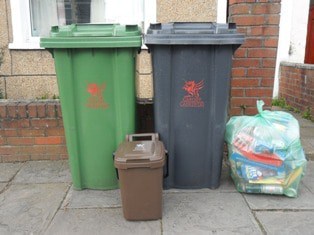
Cardiff’s plans approved at a meeting of the committee yesterday (March 10) would see current 240 litre black bins exchanged for smaller 140 litre containers, while areas with black bags will be limited to 2.5 ‘bespoke’ waste bags per fortnight.
Around 4,000 households would also receive a new 140L black bin and a 240L garden waste bin – while an additional 5,500 will receive a new 140L black bin and reusable garden sacks.
Registered ‘larger’ families will be able to keep their 240L residual waste bins, with flats and communal areas to be assessed on a ‘block by block’ basis.
Strategy
The measures were originally floated in Cardiff’s ‘Waste Management Strategy 2015-2018’ – which was launched in October last year (see letsrecycle.com story).
It was one of two options that the council consulted residents on, with plans to pilot a four-weekly residual waste collection scheme also put forward as a way to boost recycling in Cardiff.
However, while the results of the consultation have yet to be published, a spokesman for Cardiff council said the residual waste restriction was ‘more popular’ with residents than the four-weekly scheme.
Currently, Cardiff council collects residual household waste in black bags or black wheeled bins on a fortnightly basis, while both food waste and commingled recycling is collected every week.
Fines
The plans to reduce residual waste capacity will be presented to the council’s cabinet in April. It is hoped the restriction will help the council avoid an £800,000 fine imposed by the Welsh Government on councils which fail to meet its 58% recycling by March 2016.
In 2013/14, Cardiff actually fell back from 52.1% to 49.7% – the only council in Wales to drop below last year’s statutory target of 52% (see letsrecycle.com story).
In October 2014, the environment committee wrote a letter addressed to councillor Bob Derbyshire, cabinet member for environment, expressing its concern at the ‘very high’ recycling and compost targets set by the Welsh Government.
It noted that the long-term target of 70% by 2024/25 and the short term target of 58% by 2015/16 were ‘exceptionally high’ and posed significant challenges to the council, arguing financial difficulties meant it was struck ‘between a rock and a hard place’.
It added that the prospect of £200 per tonne fines for failing to meet recycling targets and the potential loss of its waste management grant ‘merely added to the headache’, while the targets were deemed ‘completely unrealistic’ for inner city areas.
Funding
Welcoming the residual waste restriction this week, Cllr Derbyshire, said he was ‘confident’ that Cardiff could meet the 58% target due to funding for additional education and recycling enforcement officers.
He said: “There is no doubt that Cardiff faces challenges which other Welsh local authorities do not. The Welsh Government targets are challenging but they set the standard in the UK and remain the right thing to do from an environmentally sustainable point of view.
“I will ensure that we rise to this challenge by delivering a recycling waste strategy for the medium term which is fit for purpose, will reduce residual black bag waste and bring about increased recycling rates for the city. I will continue to work closely with Welsh Government Ministers and officials to ensure this ambition continues to be realised.”


Register for free to comment