

Presentations to delegates representing the local authority recycling sector came from England, Scotland, Wales and Northern Ireland.
England
The event first heard from St Albans council in Hertfordshire. A comprehensive collection system was key to helping St Albans achieve the top recycling rate in England in 2020/21, according to the city and district council’s strategic director, Chris Traill.
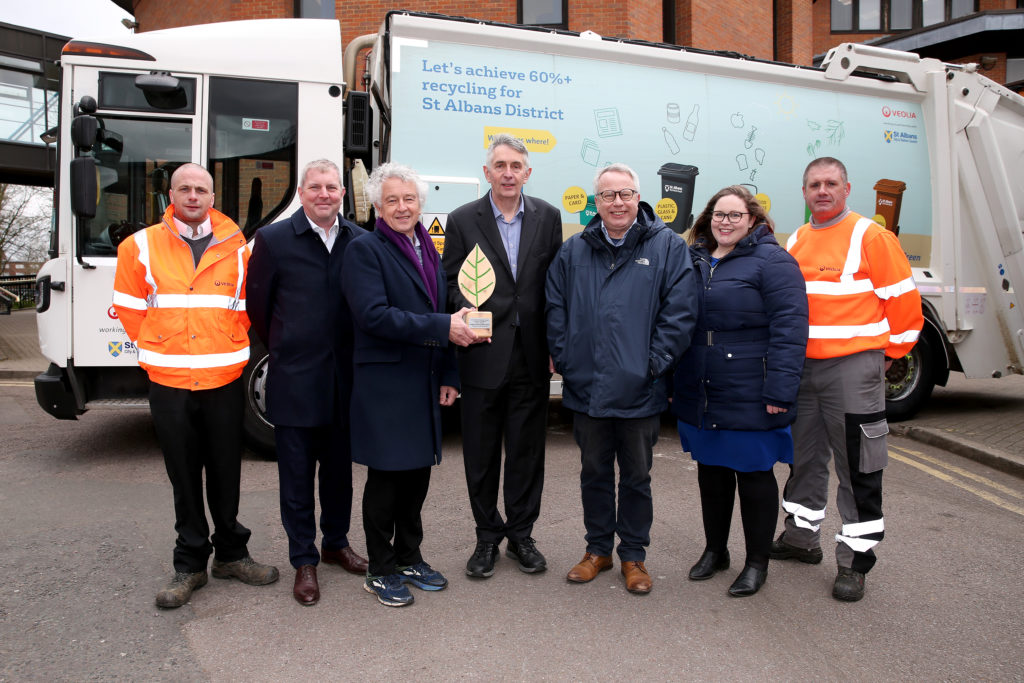
Ms Traill outlined some of the steps that contributed to the council 64.2% recycling rate. She explained that one of the council’s priorities in 2021 was to reduce costs of waste going to landfill, of about £100 per tonne, to be able to reinvest. She highlighted the “comprehensive” methodology used by the local authority, which put emphasis on weekly food waste, textiles and waste electrical and electronic equipment (WEEE) collection from the kerbside.
The council collects residual waste and recycling on a fortnightly basis, with mixed recycling such as plastics, cans, foil and glass collected separately from paper and card. Ms Traill added that the separation of the elements of recyclables helped minimise contamination.
Ms Traill reasoned that it is important to provide equally good service to flatted properties “to make sure they feel included and educated in the process”, adding that recycling in flats will be a “key focus”.
Scotland
Turning to Scotland, South Ayrshire council introduced a charge for bins not put out on time or with the wrong items in to tackle contamination, according to the council’s service coordinator, Paul Dougall. The fee is set at £25 for each different colour of bin per week.

Speaking at the LARAC conference, Mr Dougall also mentioned the lack of recycling infrastructure for flatted properties, which contributed to the contamination issue.
To help address this, the council worked in partnership with the housing department, which funded infrastructure changes, introducing reconfiguration and new bin design with restrictors in communal areas.
Mr Dougall pointed out that the council also rolled out an app to help inform residents on their collection dates and what goes in each bin, titled SAC My Bin App.
South Ayrshire has a recycling rate of 56%, which is Scotland’s third best. The council currently collects residual waste on a three-weekly basis, with dry mixed recycling such as plastic, metal and carton collected separately from paper and card every four weeks. Food waste is collected weekly, with glass collected every six weeks.
However, Mr Dougall added that since the introduction of a deposit return scheme in Scotland is only 10 months away, the council is looking at remodelling its collection system.
Wales
Sarah Edwards, chief environmental services manager, at Pembrokeshire council gave the Welsh perspective in a presentation entitled ‘A small country with big ambitions’.

With around three million people and 22 local authorities, Wales has received global recognition for its recycling achievements. The work on recycling had started a long time ago, said Ms Edwards, pointing to the Wise about Waste work in 2022. A number of schemes had taken place over the years including the Welsh Government’s Recycling Blueprint document in 2011 as part of its municipal sector plan. “This really looks at how the Welsh Government thought what was the best way to collect recycling.”
Pembrokeshire had achieved 73.2% and was top of the Welsh table in 2020/21, she said. The collection followed the recommendations in the Blueprint document with kerbside sorting of recyclables. The figure given was for the total recycling of municipal solid waste (MSW), with the overall figure for Wales at around 64%.
However, Ms Edwards did note that when comparing figures for waste from households across the UK, the recycling rate for Wales is lower than the MSW figure, at 56.5%.
Northern Ireland
Lynsey Daly, head of waste strategy and contracts for Antrim and Newtownabbey borough council, gave the Northern Irish view.
Ms Daly noted that in Northern Ireland there was some uncertainty over targets: 65% recycling was an aim for 2035, whereas the Climate Action Bill had a 70% figure. “We are looking at single use plastic bans, DRS, EPR, collaborative change models and common household collection regulations.”
The Antrim and Newtownabbey borough has a relatively affluent population and had achieved 60% recycling in 2021/22 with around 27% of waste going to landfill and 15% to energy recovery. Some 80% of materials sent for recycling stayed in the UK and Ireland for processing.
We are looking for government funding to harmonise and fund weekly kerbside sort
The borough is formed of two legacy council and has 25,000 properties on commingled collection and 38,000 on kerbside sorting. “We are looking for government funding to harmonise and fund weekly kerbside sort,” explained Ms Daly.

Register for free to comment