

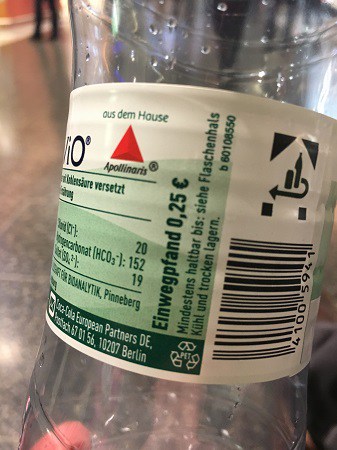
Deposit return schemes (DRS) see consumers pay a deposit which is refundable once the empty bottle or container is returned.
“In most European countries the DRS scheme came first and the kerbside came second.”
Lee Marshall
Chief executive,
LARAC

Speaking during an Environmental Audit Committee panel discussion for its inquiry on disposable packaging in Westminster on Tuesday (24 October), Mr Marshall said: “I think at the moment we are not aware that the evidence is there to say there won’t be a negative impact, so our feelings and our estimates are that there is likely to be one.”
When asked by committee chair Mary Creagh MP how much of a concern DRS diverting money away from local authorities was, Mr Marshall said: “Very, in a simple word. At the moment there’s not a lot of evidence to show what the true impacts of a DRS scheme would be in the UK.”
“In most European countries the DRS scheme came first and the kerbside came second,” he added.
Loss of income
The chief executive of LARAC, which represents recycling officers, said while there are likely to be savings on the litter side, there is also likely to be increased costs on the kerbside side from loss of income on the materials. And, Mr Marshall explained the effects would vary from local authority to local authority depending on disposal costs.
However, in terms of coffee cups, Mr Marshall explained, because the infrastructure is ‘immature’, it could be that this area could be explored more readily and would have less of an effect on the kerbside scheme.
“The discussions we’ve had is that it is on the go areas that need the attention not the kerbside side at the moment, because the coffee cups generally aren’t finding their way back into the kerbside schemes,” Mr Marshall said.
Coffee shops
Speaking about coffee cups recycling, Jakob Rindegren, recycling policy advisor, Environmental Services Association said: “A number of our members are in contact with coffee shops and paper cup manufacturers to try and find solutions and at least one of our members has launched a service offer to coffee shops and other businesses dedicated bins for paper cups and I think courier schemes for offices. So I think these solutions are coming but it’s a relatively new area.”
Cllr David Simmonds CBE, LGA vice-chairman and deputy leader of the London Borough of Hillingdon, said there was definitely not enough infrastructure to recycle plastic bottles on the go.
Both Cllr Simmonds and Mr Marshall expressed support for greater producer responsibility. Cllr Simmonds said this is where the UK is ‘out of sync’ with other European countries where producers contribute towards recycling systems.
There were also discussions regarding whether a national framework for consistency would increase plastics recycling.
The LGA vice chairman said there were ‘huge advantages’ to having a large number of different systems. He said that the systems are designed to maximise recycling in the area and are based on local infrastructure.
Mr Marshall added that the public are not confused about which set of materials they can recycle but rather the end market of the materials.

Register for free to comment