

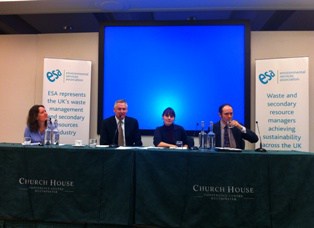
Wendy Wagler told an ESA seminar on green taxestoday (December 13) that raising the tax beyond levelsalready set out might put some landfill site operators out of business. To drive waste up the waste hierarchy, sheinstead advocated the introduction of tax relief measures to help firmsbuild recycling and energy recovery facilities.
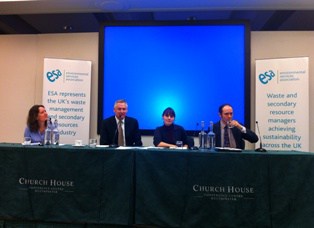
Ms Wagler acknowledged that landfill tax, which was introduced in 1996, had helped to divert waste from landfill as intended by the government.
However she explained that many operators weremerely sending residual waste in the form of refuse-derived fuel (RDF) to Europe for burning instead.
She also warned that the tax was not being applied with equal rigour across the industry, meaning that operators such as Veolia ES, whichruns 11 landfill sites across the UK, were losing out to unscrupulous operators who would only charge the lower rate of tax for standard-rated material.
At present, the standard rate of landfill tax for active waste stands at 64 a tonne and this is set to rise by 8 a year until at least 2014. The rate will then not fall below 80 a tonne until 2020. The lower rate of tax for inert waste is much lower, at 2.50 per tonne.
As a result of the tax and its abuse, Ms Wagler said that companies like Veolia were seeing landfill tonnages collapse and were considering writing their landfill assets down, as has already been done by Biffa.
Meanwhile she warned that smaller landfill operators, who could not take the hit, were at risk of going into administration, leavingenvironmental liabilities behind.
She said: We do not want a further landfill tax escalator and also wonder whether the tax is at the right level considering the economic impact of the tax and the potential environmental liabilities if operators go into liquidation.
Allowances
Instead of further increases in landfill tax, Ms Wagler advocated the introduction of tax relief for the capital costs of developing new waste and recycling infrastructure in the form of Infrastructure Allowances and Enhanced Capital Allowances (ECAs).
She said these were particularly needed because the abolition of the industrial buildings allowances has really hurt the waste management sector as it was dependent on infrastructure.
On ECAs, she said that these are currently available for energy efficiency and water saving plant and machinery and provide 100% tax allowance in the first year, but are not available for recycling technology or energy recovery facilities.
She explained that one ES plant, the Sheffield energy recovery facility, had managed to qualify for ECAs due to the fact that it provided district heating but this was an anomaly and Veolia had not received much tax relief for much of its other expenditure.
For instance, there was no tax relief available for 28% of expenditure on facility Southwark Intergrated Waste Management facility, she explained.
She said: What we feel was really missing from the recent Autumn Statement was the introduction of infrastructure allowances and enhanced capital allowances for recycling and recovery operations. Those allowances would really cash flow in times of high PFI investment and attract outside investment.
ESA
Ms Waglers eagerness to see no extension in the landfill tax escalator echoed the position of Jacob Hayler, economist at the ESA, who presented the findings of the recently published ESA report on green taxes. The report claims that extending the landfill tax escalator is not the answer as it would heavily penalise waste producers and in particular local authorities who are under financial strain and instead makes a number of alternative recommendations, such as a tax on peat (see letsrecycle.com story).
He said: We think it would be wrong for government to take the easy option of increasing the landfill tax escalator and we have to focus as high up the waste hierarchy as possible.
However, Julie Hill MBE from the Green Alliance think tank suggested that landfill tax could incentivise more of a closed loop economy.
She said: It seems to me that increasing landfill tax further will incentivise more alternative treatment.

Register for free to comment