


The ‘Kerbside Collection Options: Wales' study was commissioned by WRAP on behalf of the Welsh Assembly Government. It examines the relative merits of different dry recycling collection systems and will be used to develop the framework within which councils in Wales are expected to recycle 70% of household waste by 2025.
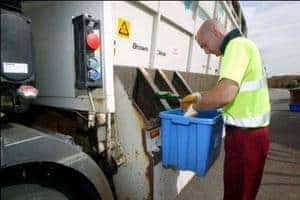
It concludes that the kerbside sort option “consistently outperforms” the other two systems and that this is particularly the case when looked at as part of an ‘enhanced performance scenario'. This is what the system would be like if Wales was recycling 70% of its waste and if every council provided weekly collections of dry recyclables and food waste and fortnightly collections of residual waste, with 95% of residual waste being sent to CHP incineration.
The reason for the difference – particularly in financial terms – is because material which is collected at the kerbside does not incur the cost of being sent to a materials recycling facility (MRF) and recyclables collected in this way can usually command a higher price.
Other findings include:
-Commingled and two-stream collection systems could be expected to achieve higher yields of collected dry recyclables, relative to kerbside sorting. However, when material rejected at the MRF, by secondary processors and by reprocessors is taken into account, differences in tonnage actually recycled between the systems appear to be marginal.
-Improved environmental outcomes are associated with the typical fates of kerbside sorted material as opposed to co-mingled and two-stream material, both in terms of benefits of recycling and impacts of onward transportation.
-In terms of financial cost, when optimised systems are compared for all options, kerbside sorting does appear to have the potential to offer a lower overall cost.
-The advantages of kerbside sorting appear to increase as recycling performance increases. In turn, the advantage of two-stream over co-mingled collection appears to narrow as performance increases. These results suggest that Welsh local authorities will face a challenge in adapting collection systems that may work well now, but may become increasingly sub-optimal as recycling levels increase towards the 70% target.
Welcomed
The findings were welcomed by Welsh environment minister Jane Davidson – who has long been an advocate of kerbside sort, despite this causing some friction between the WAG and some Welsh local authorities (see letsrecycle.com story).
The results will feed into the WAG's Municipal Sector plan for waste, which is due to be launched on March 10.
She said: “This report is an important part of our evidence base, since it recognises both the environmental and economic cost of different recycling methods. Its findings will inform the Municipal Sector Plan, and I hope that local authorities will also use them to develop the sort of recycling services which work best for them.
“I also want to use this opportunity to thank Welsh local authorities for their hard work, and congratulate them for contributing to Wales reaching its highest-ever recycling rate. I urge them to keep up the good work, to continue working together wherever they can, and to use all the evidence available to develop the high recycling society that everyone in Wales deserves.”


Register for free to comment