



The findings came in a long-awaited report on the trials, published last week without fanfare, which is expected to feed into draft regulations currently being drawn up for the collection, treatment and recycling of waste batteries as the UK looks to meet its Battery Directive target to collect 25% of waste batteries by 2012 and 45% by 2016 (see letsrecycle.com story).
The trials, which varied in length, involved 940,000 households across the UK trialling one of six collection methods. As well as council-run kerbside collections, these included: community sector-operated kerbside collections, community drop-off, postal, retail take-back and, NHS and fire service collections.
The highest average set-up costs were recorded by the postal trial, which cost an average of £10,800 per scheme, although the service was found to be effective for people with no access to kerbside facilities. This was compared to £3,800 for a kerbside service run by the community sector, £5,300 for local authority-run kerbside collection and £8,100 for retailer take-back.
As well as its high set-up costs, retailer take-back also incurred significantly higher collection costs than the kerbside option, costing £101 per kilogram of batteries collected, compared to between £4 and £12 per kg for kerbside collections.
Over the course of the trial; kerbside collections captured by far the most batteries per capita – working out at an average of 81 grams as opposed to 34g for postal, 22g for retail take-back and 12 grams for community drop-off.
Summing up the report, WRAP said that local authorities “should be encouraged to collect batteries through, for example, kerbside collection schemes, as these types of schemes have shown the best per capital collection rate.”
However, WRAP stressed that as the Battery Directive was a producer responsibility directive, local authorities should not be expected to bear the costs, claiming that a mechanism would ne need to reimburse them and incentivise them to manage total costs effectively.
It said: “A mechanism will be needed to reimburse local authorities for their additional costs but at the same time local authorities will need an incentive to manage total costs effective. This could either be achieved by separate negotiation between compliance schemes and individual local authorities or through a central negotiation with national or regional representatives of local authorities.
“For simplicity a single national figure per collected tonnes could be agreed with LARAC, or another similar body, and if local authorities wished to participate at this level they could do so. If they did not then compliance schemes could use altenative collection routes,” it added.
WRAP also emphasised the importance of public awareness, stating that: “A national awareness campaign is necessary to ensure the success of collection schemes. Local press releases are useful and personal but to build the momentum and awareness needed to meet the targets a national campaign will be needed.”
Kerbside
Batteries can be collected successfully as additions to existing collection networks and require only very limited modifications to the collection vehicles and other facilities
WRAP
The results of the kerbside collection trials appear to confirm the opinion expressed by councils involved in the trials while they were running that they were a “huge success” (see letsrecycle.com story).
The WRAP trials involved 482,000 households across 15 council areas being provided with a sealable bag or box for batteries, which would be collected alongside existing recycling collections.
The report showed that kerbside collections yielded an average of 7.9 batteries collected per household during the trials, compared to just 1.7 for retail take-back, 1.04 for community drop-off and 2.9 for the postal option, with a similar pattern for the estimated weight collected per capita.
In the past, the option of adding batteries to kerbside recycling collections had been questioned by both the Local Government Association (see letsrecycle.com story) and the Campaign for Real Recycling (see letsrecycle.com story), due to cost and contamination concerns.
But, the report was positive about the potential for kerbside collections to be introduced with relative ease.
“Batteries can be collected successfully as additions to existing collection networks and require only very limited modifications to the collection vehicles and other facilities, if any,” it claimed.
It cited the public's prior experience of kerbside recycling collections as another factor benefiting the option, as well as the fact that “well-designed schemes reported only limited additional crew time costs”.
The report acknowledged that distributing both the containers and scheme information “can be expensive”, but suggested that completing the task at the same time as distributing newsletters or recycling calendars could help.
It concluded that: “The kerbside trials collected the greatest amount of batteries and covered the greatest number of households, but even allowing for this, and the longer trial period, were still significantly more effective.”
Postal
Despite the expense in establishing postal schemes, the report was also positive about this option, particularly within rural areas.
In total 38,000 households in the rural areas of Dumfries & Galloway and Eden in Cumbria were provided with a supply of freepost polythene envelopes to recycle their waste batteries.
And, the report stated that: “Although relatively expensive to run and therefore not appropriate for all locations, the postal scheme has been found to be effective at collecting batteries from households without adequate access to kerbside collection facilities or bring schemes.”
It added that: “This collection method could also be extended for use in a number of other specific situations and potentially for obligated 'remote sellers' e.g. internet sales.”
Retail take-back
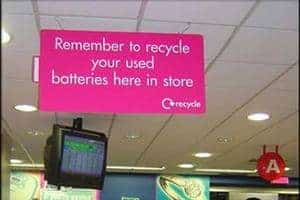
The trial saw 33 high street shops across three areas – Eastleigh, Swansea and Perth & Kinross – providing special collection containers for batteries to be left in.
However, take-back recorded the lowest level of awareness and actual reported usage by respondents to a WRAP-commissioned survey of the trial areas which took place at the end of last year.
The report stated: “Retail take-back should have been a good way to collect batteries, building on people's regular shopping habits; however, it hadn't proved the most popular or produced the highest capture rates.”
And, with distributors of portable batteries widely expected to have to provide an in-store collection service under the UK system, its high costs suggest the Directive could have a major financial impact if retailers are to fulfil their obligations – amounting to £100, 000 a tonne the first year and £10,000 a tonne thereafter.
But, the report did suggest that: “These schemes could still prove effective if they are adopted and promoted corporately by retailers so ensuring better locations of the collection containers; 'buy-in' from local managers and staff and resolution of transport issues.”
Community drop-off
The community drop-off option was introduced to three council areas – Falkirk, Camden and Cherwell – with collection containers in places such as museums, shops, council offices and, in Camden, on the street.
While it covered a similar number of households to the retailer take-back option, the drop-off method produced a far lower total weight of batteries (5.7 tonnes compared to 10.4 tonnes) – though it did entail lower set-up costs (£5,300 per scheme compared to £8,100) and also running costs.
NHS and Fire Service
“Small scale” trials were also set up via three NHS bodies and a fire service, collecting batteries from audiology departments, home visits and from equipment used in day-to-day work.
These provided a lower cost-per-scheme option than the community drop-off option, but at a far higher cost per kilogram of batteries collected (£42 per kilogram, compared to just £10 for retailer take-back and community drop-off).

Register for free to comment