

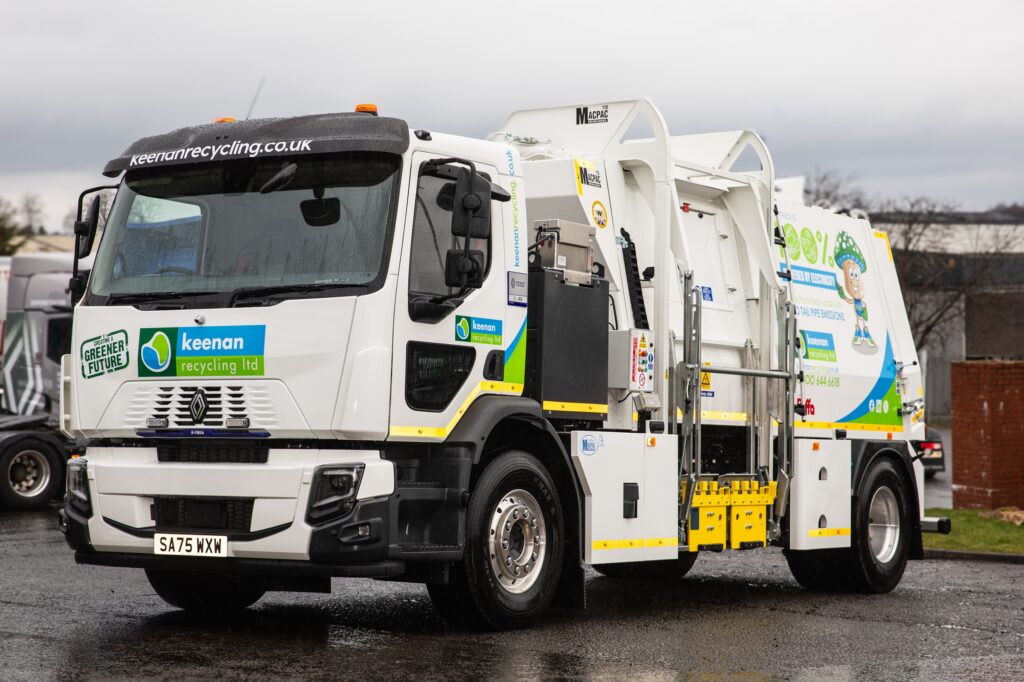
The 20-tonne battery-electric vehicle has been developed specifically for food waste rounds and is expected to operate with zero tailpipe emissions.
The project was delivered through a collaboration with Renault Trucks, Macpac Refuse Bodies, Keenan Recycling and group parent Biffa, with capital support from Scottish Enterprise.
The vehicle represents a total investment of around £460,000, including a £90,000 grant contribution.
Fergus Healy, former Head of Strategic Development and Net Zero at Keenan Recycling, who led the funding process, commented: “This vehicle represents far more than new technology. It’s proof that ambition, collaboration and persistence can deliver real, practical change.
“Working closely with Scottish Enterprise, Renault Trucks, Macpac and our colleagues at Biffa, we were able to secure funding and overcome complex engineering challenges to bring Keenan’s first ever electric food waste truck to life.”
New electric food waste vehicle
The new unit is based on a fully electric Renault Trucks D18 Wide chassis and fitted with a Macpac 110 food waste collection body.
It has been purpose-engineered to meet the operational and payload requirements associated with separate food waste collections.
According to the project partners, the chassis is equipped with four 94kWh batteries, providing around 300kWh of usable energy. The vehicle is expected to achieve a real-world operating range of just under 180 kilometres per charge, depending on route and duty cycle.
To accommodate the side-loading food waste body, the battery packs have been relocated behind the cap.
Aaron Davison, Sales Engineer – Electromobility, Renault Trucks UK & Ireland, explained: “The side-mounted battery configuration was a first for Renault Trucks in the UK, and demonstrates the strong collaboration between our teams, working together with Macpac and Biffa to deliver the right vehicle solution for food waste collection.
“With zero tailpipe emissions, low noise and excellent manoeuvrability, it is ideal for operating in busy urban environments while delivering significant CO₂ reduction compared to diesel.”
The chassis was manufactured in France, with the specialist food waste body built and installed in Belfast before entering service in Scotland.
Decarbonising the fleet
The electric vehicle joins Keenan Recycling’s existing fleet, which includes vehicles operating on biofuel and compressed natural gas, as well as Hydrogen+HVO-ready units.
The company said that the addition of a battery-electric food waste truck forms part of its wider net zero and fleet decarbonisation strategy.
Darren Judd, Head of Fleet Development at Biffa, added: “At Biffa we are strong believers in decarbonising our fleet and reducing emissions from road transport.
“Specialist waste vehicles are not standard logistics trucks. They require extensive modification to achieve the payloads, ranges and operational performance we need.
“Working in partnership with Renault Trucks, Macpac and Keenan Recycling has been critical in making this vehicle viable and in helping both organisations move closer to our Net Zero ambitions.”

Register for free to comment