

According to a ‘key issue paper’ issued by the International Solid Waste Association (ISWA) last month, confusion exists over the range of ‘environmentally friendly’ alternatives to traditional polymers on the market and the effect these have on marine environments and land.
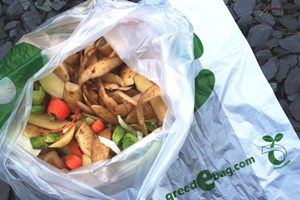
ISWA has close links to the biodegradable plastics sector, through its president David Newman – who is also managing director of the Bio-Based and Biodegradable Industries Association (BBIA).
The paper, compiled by ISWA’s Biological Treatment of Waste Working Group, notes: “Biodegradable plastics are viewed by many as providing more ‘environmentally friendly’ alternatives to these traditional (non-biodegradable) plastic polymers; however, they too have both advantages and disadvantages.”
It adds that there is a ‘confusing array’ of terminology associated with biodegradable plastics, with words such as ‘bio’, ‘degradable’ or ‘compostable’ used interchangeably despite having different technical meanings which impact upon the way the polymer can be used, recycled or disposed of.
The paper outlines that four distinct polymer types exist, including:
- Biodegradable plastics: which can be broken down into their constituent monomers and metabolised naturally over a period of time;
- Compostable plastics: which are capable of decomposing in a compost site into carbon dioxide, water, inorganic compounds and biomass, leaving no toxic residue;
- Bioplastics: plastics derived from plant-based polymers such as corn-starch, which depending on their make-up could be either biodegradable or compostable or exhibit the properties of conventional plastics, and;
- Degradable plastics: which disintegrate into smaller fragments, undergoing significant changes in their physical structure under specific environmental conditions.
The report also highlights oxo-degradable plastics, which are made by introducing an additive that accelerates the degradation of some types of conventional plastic when exposed to heat and/or light. ISWA claims that as it is unknown how long it takes for oxo-biodegradable plastics to decompose, it is unwise to dispose of them in home or industrial composting facilities.
More generally, ISWA notes that some biodegradable plastics can be particularly suited to recycling alongside organic wastes, but as they are functionally similar to conventional plastics, can lead to contamination in other plastic recycling streams.
Certification
The organisation went on to state that, for consumers, biodegradable plastics are difficult to distinguish from conventional plastics and in order to avoid contamination of organic waste for composting, awareness and education initiatives – including suitable certification schemes –help to allay confusion.
The report adds: “A certification label scheme facilitates the appropriate use of biodegradable plastics by consumers. In addition, it is also helpful to make customers aware about the distinction between compostable products suitable for use in home composting and larger-scale industrial plants.”
Compostable material
Currently the EN 13432 standard defines what characteristics a material must have in order to be defined as ‘compostable’. These properties include:
- Biodegradability: the ability to break down into carbon dioxide, water or biomass at the same rate as cellulose (paper);
- Disintegrability: the material is indistinguishable in the compost, is not visible and does not need to be screened out;
- No heavy metal content: there is a limit value for the content in compostable plastics, and;
- Eco-toxicity: the material produced from compostable plastics has no negative effects on composting.
The report explains that these certification standards are normally in place to ensure total biodegradability of plastics within industrial processes, where the degradation can be different from home composting.
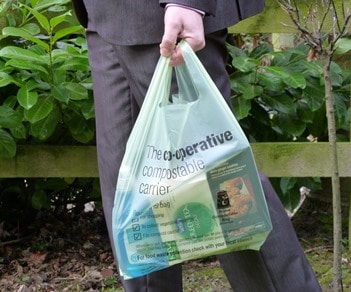
In the UK, the EN 13432 standard is widely recognised as an acceptable input material to commercial composting systems, including those that comply with BSI PAS 100 for composted products.
With regards to plastic bag usage, ISWA suggests applying a standard code or pattern for organic waste collection bags may help the public and waste collectors to be better able to recognise compostable plastic from non-biodegradable ones, although this requires further research.
The report concludes: “There is a need for improved promotion by local governments to raise awareness about biodegradable plastics and their correct use. There is the possibility to develop a globally recognised label based on the ISO standard, and this should be investigated further.
“Overall, the potential dis-benefits associated with the use of biodegradable plastics are outweighed by the benefits that can be achieved through the efficient and effective collection and treatment of organic wastes made possible through their use.”

Register for free to comment