

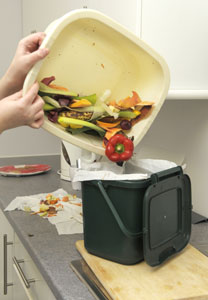
Under the review, which is due to be published next month, the government wants to tackle food waste and is understood to be considering providing some funding to help councils to collect food waste separately.
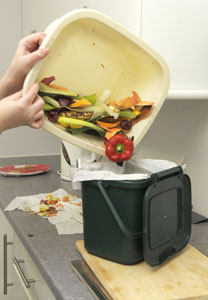
This idea is thought to be popular with ministers because it would not only help divert food waste from landfill but would also make good a pledge by communities secretary Eric Pickles to help councils bring back weekly waste collections (see letsrecycle.com story).
While Mr Pickles was originally talking about weekly residual waste collections, weekly food waste collections are seen as something of a compromise which would fit in with Mr Pickles aims while also not damaging the good work achieved by councils in driving residual waste levels down.
However, the Local Government Association (LGA) – which represents councils across England and Wales has warned that plans to tackle food waste could sit badly with local government if the funding is not sufficient. It has also warned that separate collections may not be suitable for every local area.
At a meeting with environment secretary Caroline Spelman and local government minister Bob Neill on March 31, the organisation, represented by chair Margaret Eaton, stressed that if any extra money was available to fund collections, councils did not want it ring-fenced and wanted to spend it how it saw fit.
And, it said there were other ways of diverting food waste from landfill than collecting it separately through methods such as waste prevention, incineration and mechanical biological treatment. The LGA also wants retailers and businesses to play a larger part in cutting waste.
Food
Martin Wheatley, programme director for environment and planning at the LGA, who requested the meeting, told letsrecycle.com: The LGA had a meeting on March 31 in which our chair, Margaret Eaton and others met with Caroline Spelman and Bob Neill. The subject of food waste was dealt with.
The issue was what options are there for taking food waste out of landfill. Clearly weekly separate collections are one method councils are using already but we were making the point that there are other ways to stop food waste ending up in landfill. We are keen on the place of food waste to be thought through holistically in the waste review, with not an exclusive focus on collection.
Mr Wheatley stressed that it was the outcome getting waste out of landfill which should be encouraged and therefore any financial or expert help should be targeted at this, rather than disproportionately favouring separate food waste collections.
Due to the governments localism agenda, it is expected that it will not go so far as to make separate food waste collections mandatory in England. This is a more cautious approach than in Scotland and Wales, where separate food waste collections must be introduced. In Wales, every local authority already collects food from the kerbside from at least some of its residents.
Cautious
Related Links
One of the reasons that ministers are targeting food waste is because they are under considerable pressure to cut carbon emissions. Biodegradable waste such as food waste accounts for 90% of the direct emissions from the waste sector. The waste sector in turn accounts for 3-4% of UK greenhouse gas emissions. Tackling it therefore forms an important strand of Defras Carbon Budget strategy.



Register for free to comment