


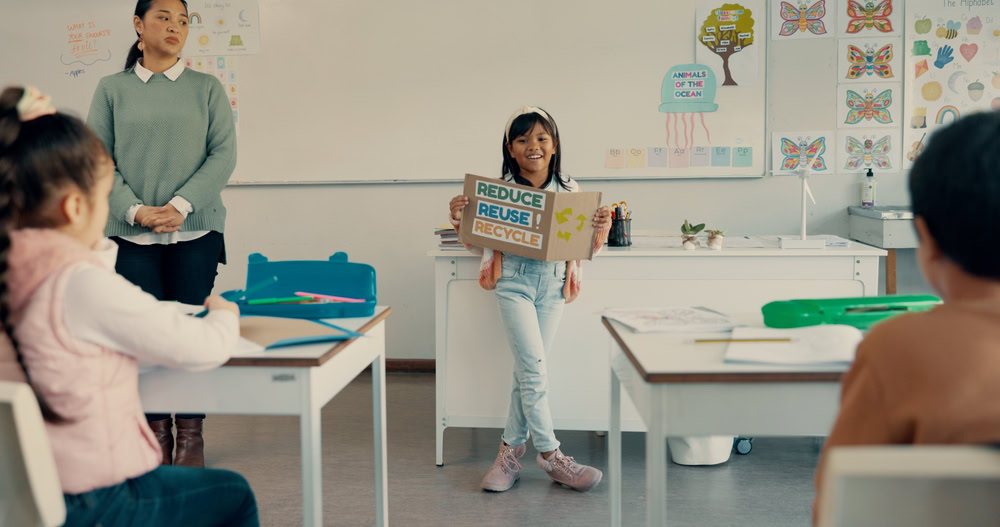
The announcement follows the publication of the Curriculum and Assessment Review, chaired by Professor Becky Francis, which was commissioned in July 2024 to consider how schools can better equip pupils for a modern workplace.
Responding to the review’s recommendations, the Department for Education said reforms will be introduced across both primary and secondary phases, with a focus given to climate education, sustainability and green skills.
‘Greater focus’ on climate education
With climate change currently mentioned only briefly within the Science curriculum and not explicitly referenced in the purpose of study for Geography or Design and Technology (D&T), the review concluded that this lack of visibility is a barrier to building an effective climate education framework.
“Young people have been clear about their desire for a greater focus on this area in their education,” the review noted, stating that climate education is “critically important to the economy” and essential for developing the green workforce of the future.
The Department for Education said it recognises the “significance of climate change for our society and the planet,” and that schools must play a vital role in helping pupils understand “the climate crisis’s causes, consequences and possible solutions.”
Commenting on the decision, Dr Adam Read MBE, Chief Sustainability and External Affairs Officer for Suez in the UK, said: “Understanding sustainability, resource management, and the environmental challenges our children will face is no longer optional; it is a fundamental life skill for the next generation of consumers, innovators and employees.”
Science and Geography
The review found that the Science curriculum makes “only limited reference” to climate science or scientific work to combat climate change, and that some content is outdated.
Revisions will ensure that students explicitly develop an understanding of the scientific principles underlying climate change, the global efforts to mitigate it and the role of science in sustainability.
Climate science will be better integrated across biology, chemistry and physics, replacing fragmented references with a more coherent approach designed to highlight the links between scientific disciplines and environmental systems.
The current Geography curriculum, the review said, also has “notable gaps” in its treatment of climate change. Future revisions will embed climate and sustainability more explicitly across key stages and topic areas, including physical geography, human geography and geographical applications.
The purpose of study will be amended to include explicit wording around climate change.
Read added: “If we can raise the next generation to appreciate our impact on the planet, the development of a truly circular and sustainable economy will be more than achievable, it will be inevitable.”
Design and Technology
The review identified D&T as a “key subject” where green knowledge and skills could be integrated.
It highlighted that the current programme of study for D&T does not explicitly mention sustainability or the benefits of a circular economy.
The review therefore recommended that the D&T curriculum be revised to embed sustainability and circular design thinking at every key stage.
Recommendations included developing critical decision-making skills around material selections and weaving social responsibility and inclusive design throughout the design process.
The Chartered Institution of Wastes Management (CIWM) commented: “We particularly welcome the emphasis on Design & Technology as a key subject for developing understanding of circular design, repairability, and product lifecycles.
“This represents a significant opportunity to help young people develop the mindset and skills needed for careers in the green and resource sectors.
“However, it will be critical that the next phase of curriculum development involves meaningful engagement with industry to ensure that the content meets future workforce and industrial needs.
“Adequate resourcing, teacher training and appropriate pathways for 16–19 education must also be prioritised to deliver these ambitions effectively.”


Subscribe for free