

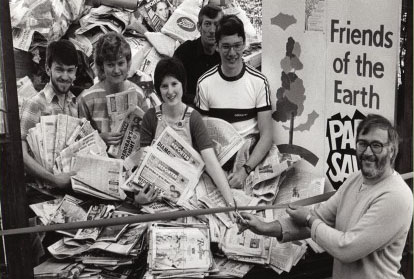
The lecture, “Golden years – recycling and resources, the past present and future” was delivered last week by Ray Georgeson MBE, consultant and chief executive of the Resource Association.
While reflecting on a lifetime of positive involvement with recycling and resource management, Mr Georgeson, who was speaking on a personal level, also levelled strong criticism towards current government attitudes on recycling, suggesting “a rod” be taken to Defra and the government.

The event, organised by Resource Media and held in Westminster, commemorated Kit Strange a pioneer in writing and talking about recycling and resource management who died in 2012 (see letsrecycle.com story).
Mr Georgeson started his speech by recalling the “very inquiring mind” of Kit Strange, “who was always looking for more knowledge and foresaw the future of resource management.”
Zambia
Then, turning to his own childhood, Mr Georgeson reflected on how he had been brought up in Zambia where he moved with his family at the age of two. “I was given a brand new train set, a Hornby clockwork one which was my present for leaving home… What I liked more was watching the kids who made toy cars out of wire, they made cars out of scrap from nothing. I really wanted the wire car and I think this helped shape my attitudes to stuff.”
He ran through his early involvement in the sector and praised the work of others including Friends of the Earth in Bath and Bristol, in particular Jane Stephenson and Andy Moore – “Avon Friends of the Earth”, said Mr Georgeson, “they were the pioneers of recycling.”
Recycling officers were few and far between in the 1980s and early 1990s, in fact just a handful existed, said Mr Georgeson. Recycling was encouraged at a number of local events and his own involvement saw him involved with Friends of the Earth in newspaper recycling on Merseyside (as pictured). And, of special significance, was the talk of targets at the “Towards 25% recycling” event held at the University of Liverpool in September 1993 with the support of the now Baroness Gloria Hooper.”
Referring to the 1990s, when he was involved with the charity Wastewatch, he noted that this is “sadly no longer with us. Wastewatch really was picking up and leading, particularly with government, on the role of the voluntary and community movement, some might say sector.”
Landfill tax
The big change, suggested Mr Georgeson came from “the Conservatives in 96/97 who did introduce the landfill tax even though it came into force with the Labour government in 1997. We also had the landfill tax credit scheme and a lot of learning went on and undoubtedly there was a growing understanding of the need to educate the public.”
The golden age of recycling that the speaker referred to in his title stemmed in part from the idea that markets needed to be developed for recyclables and he recalled how the UK had developed links with David Dougherty, who ran the inspirational Clean Washington Center in Seattle, who was involved in the development of markets for the recyclables.
Highlighting the “strategic and industrial edge” that the Clean Washington Center had, Mr Georgeson pointed to his own involvement with WRAP, the Waste & Resources Action Programme, which “was invented as part of the Waste Strategy 2000.
“WRAP did an awful lot of things well. They were brave, we had to break fresh ground and we certainly didn’t please everybody in our broad spread of stakeholders.”

And, explaining that a lot of work had been carried out by WRAP, he told his audience: “Some of it was really good, some was a terrible waste of money.”
Acceleration
Highlighting the golden age, Mr Georgeson said that he had witnessed “an acceleration of composting and recycling through the late 90s and the noughties. There was a real momentum, a real acceleration going on.”
But, the picture was different now. Showing a chart with a rise in recycling rates but with data stopping at 2010, he declared: “Truly I couldn’t put the beyond 2010 number in. We do appear to be struggling on what we are going to do in England – I know it is different in Scotland and Wales. We are frustrated in this room at what is happening, in this house [Parliament] and down the road at Nobel House [Defra].”
There is a weakening of confidence in local authorities, partly because the previous government had removed statutory targets, claimed Mr Georgeson. “And, we can blame Eric Pickles, the mood, tone and ultimate interpretation that has come from his malign approach to waste policy. The negativity and policy of Eric and his people are a serious dampener on our ambitions as a nation.”
‘Perfect storm’
Adding in the downturn in China and weaker commodity markets, this has led to the shaping of a perfect storm of turbulence, he added, also pointing to the loss of Closed Loop with the failure of voluntary agreements to use recycled plastic and instead dairies switching back to using virgin material for bottles.
Turning to his current position, Mr Georgeson emphasised that “if the materials are collected and sorted well and delivered well, they will command decent prices,” and he explained that the Resource Association, is “a championing voice for the recycling and resource sector. We have a good long term future and need some strategic support from government.”
“Stay strong, stay focused in what you all do in your different ways. We have to hold together in the face of domestic difficulties and global environmental pressures”
Ray Georgeson
Director, Ray Georgeson Resources

In conclusion, he told the audience he wanted to highlight “four things”.
One was to tackle inaction at Defra and the UK government who are “not saying what we think should happen…. we are going to negotiate hard for a year or two we hope to turn a corner with Defra and get some support from them.” Mr Georgeson commented: “We really need to stick a rod up the back of Defra and the UK government.”
Referendum
With regard to the EU referendum, he urged delegates that if they “honestly believed, that this industry believes we should stay in Europe and make it work better, we need to speak out and not be complacent … even if we do nothing more than speak to our workforces, it would be a dereliction of duty if we don’t. We can join forces and we mustn’t avoid complacency on this issue.”
Thirdly, Mr Georgeson suggested that pay as you throw, which had been shown to increase recycling rates, should be considered. “This is part of what an active and enabling state can do, if it did nothing more than enable it.”
And, he mentioned the important role of the WasteAid UK charity which is developing its work.
Delegates were then urged by Mr Georgeson to “Stay strong, stay focused in what you all do in your different ways. We have to hold together in the face of domestic difficulties and global environmental pressures.”

Register for free to comment