

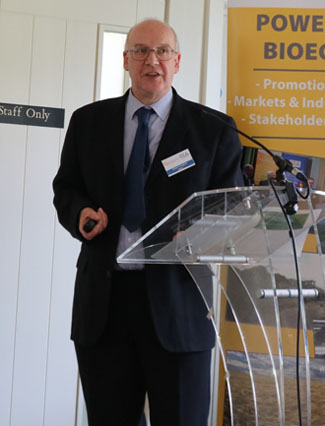
Addressing the annual conference of the Organics Recycling Group at Quarry Bank, Cheshire, Robert Vaughan, head of household waste collection and recycling policy at Defra, explained the Resources and Waste Strategy consultation on food waste. He told delegates that food waste will have to be collected separately and weekly, but indicated that treatment options are not prescriptive.
Some in the organics sector have raised concerns that the Department wants, via the Strategy, only to see food waste going to anaerobic digestion plants. But, Mr Vaughan explained: “We are proposing presenting food waste separately regardless of the treatment route. We recognise the role of IVC and other treatment options so we don’t want to lock ourselves into one technology by default.”
He added that the food waste weekly from households plan is just part of the consistency programme proposed in the strategy, which is now out for consultation, and that the overall aim is for a 65% recycling rate by 2035.
Fine line
However, despite what some see as a possible concession by Defra over treatment routes, the idea of separately presented food waste remains a matter of controversy as the conference heard. At issue appears to be the fine line of how householders actually handle the food waste, whether it goes into a food waste bin or alternatively into a wheeled bin which could also take green waste.
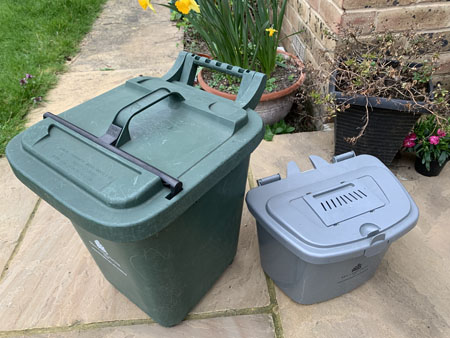
Delegates were told by Ralph Kemp, corporate manager commissioning for waste and environmental services at Cheshire East Council that the authority’s system, which is an investment in a new green waste/food waste to IVC contract “is at odds with Defra”. A proposal for an alternate weekly food waste service had been rejected by the council’s cabinet on grounds of costs and Mr Kemp pointed out that the authority’s waste service scores a high level of satisfaction from residents.
Mr Kemp said that the authority had felt that on waste and recycling services, “councils have to make decisions on this taking account of local needs and concerns”.
Consistent
In his presentation, the Defra official covered in detail the aims and contents of the consultation currently underway on consistent collections.
Mr Vaughan said that on dry recycling, Defra is proposing that a core set of six materials will be collected – paper and card; glass; plastic bottles and plastic pots, tubs and trays (PTT); metal packaging; and food waste.
On food and garden waste, he said that the Strategy suggests the “separate collection of food waste and free garden waste collections to be introduced from 2023.”
And, there will be guidance on new service standards for local authorities as well as the development with them of “non-binding performance indicators” to support “continuous improvement in performance.” The Defra official offered reassurance to local authorities at this point that for the changes, such as providing food waste collections and collecting the core materials, “we will cover the cost of new burdens”.
There is to be a further consultation shortly and this will be on food waste targets, said Mr Vaughan. Referencing costs in more detail, he said the Department “Wants to make sure local authorities are properly resourced to meet new net costs upfront and ongoing costs. We see there will need to be flexibility with existing contracts.”
He put the costs of introducing separate food waste collections for local authorities at £20 million but challenges would include poor capture rates and collecting from flats.
And, on one of the more controversial points of the collection side of the Strategy, which is for the provision of free garden waste services rather than charging (which is the policy for some authorities), Mr Vaughan argued that for garden waste collections, “the best route is a free service. Subscription arrangements result in lower recycling rates. We also support home composting but kerbside collection is the best way to increase the amount of recycling and won’t undermine home composting.”
He also said on food waste that “We think there is a role for caddy liners but would be a new cost”. Picking up further on the technology at this point, he remarked that IVCs (in vessel composting) wasn’t ruled out, but that “separate presentation of food waste is the best way to achieve yields”.
This was interpreted by some in the audience as a welcome support for different technologies for handling food waste with the idea that the householder should at least collect it separately into a caddy and food waste bin, even if it might subsequently be mixed with garden waste for treatment by IVC or dry AD. Mr Vaughan was not quite as direct in his comments on this point, however, which was viewed partly because the official was outlining policies which are still at the consultation stage.
Plastic film
Feedback from delegates to Mr Vaughan included that Defra needed to assess plastic film in the waste stream and provide a solution. Mr Vaughan replied, “With film, we recognise that this is an issue and we would be looking to give good advice to local authorities.”
Another delegate suggested “a get out clause in the consistency document so local authorities don’t have to provide green waste bins to those who contaminate their bins.”
Mr Vaughan said this was a “very good point – we are looking for views on communications to residents. We want to work with local government to ensure that the material is right.”
The official was also asked about whether transport and local conditions would be recognised in terms of costs, especially for some of the more remote parts of England such as Cornwall. He responded: “We will have to look at it when we apply the new burdens approach. It is recognised in the consultation.”
‘Equal consideration’
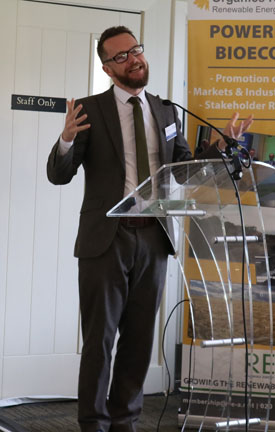
Commenting after Mr Vaughan’s presentation, Jeremy Jacobs, technical director of the Renewable Energy Association and director of its Organics Recycling Group, said: “In vessel composting and dry AD need to be given equal consideration within the Strategy and local authorities should be allowed to make the choice on technology selection. We do welcome the inclusion of organics in the Strategy and recognise the imperative of collecting as much food waste as possible from households and businesses.”

Register for free to comment