
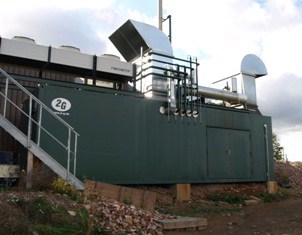
Expansion plans for Cambridgeshire AD
Nick Waterman, managing director of Local Generation, said: This is an exciting time for the Local Generation business. We will be commissioning the plant shortly and will be fully operational early in 2012. Well then start to plan the move towards 70,000 tonnes; this will divert even more food waste from landfill and further reduce greenhouse gas emissions.
“I would like to recognise the excellent support and specifically the Capital Grant received from the Waste & Resources Action Programme (WRAP) in helping us to progress this exciting project, he added.
AD plant opens in West Yorkshire
An anaerobic digestion plant at Clayton Hall Farm, near Emley in West Yorkshire, was unveiled on Friday (December 2) by local MP Simon Reevell. The 400kW capacity plant generate enough electricity to power 650 homes and will be the first in West Yorkshire to use both energy crops and food waste to generate electricity. It will process around 2,000 tonnes of food waste every year.
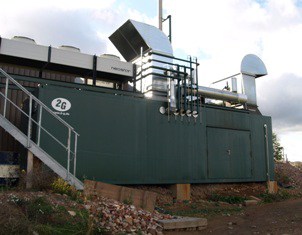
Not-for-profit low carbon organisation CO2Sense invested 600,000 in the plant and also gave technical advice to help with planning and development. Investments from CO2Sense are re-paid once plants are operational and generating an income. CO2Sense then re-invests in other renewable energy developments. To date, it has invested in 6% of the renewable energy capacity in Yorkshire.
Neil Gemmel, from Clayton Hall Farm, began developing the AD plant in 2008. He said: The launch of the plant is the result of five years hard work and we are delighted that it is now generating clean electricity. The plant is extremely efficient, using a mixture of crops and food waste that would otherwise have been sent to landfill. The digestate produced as a by-product of the plant is an excellent fertiliser and will be used on our farm as an alternative to artificial fertilisers. With help from CO2Sense, the plant has become a great success for the farm.
Wiltshires first commercial biogas plant to open
Wiltshire-based AD technology company Malaby Biogas has confirmed it is on target to begin commissioning Wiltshire’s first commercial anaerobic digestion (AD) facility in the second quarter of 2012. The Bore Hill Farm Biodigester at Warminster will process commercial food waste and catering waste as well as animal slurries, abattoir waste and spoiled non woody crops.
By the third quarter of 2012, the Bore Hill Farm Biodigester will divert up to 20,000 tonnes of food waste from landfill every year. The plant will also generate around 500kW of green electricity to feed into the national grid as well as supply renewable energy to nine business units scheduled for development on the site in 2013. The 5 million biogas plant project will additionally produce 15,000 tonnes of digestate a year which can be used as fertiliser for agricultural use. Malaby Biogas is in talks with several potential customers including farming contractors to supply them with the bio-fertiliser as an alternative to their existing petrochemical-based artifical fertilisers.
Toby Minter, who runs Malaby Biogas with his brother Thomas, said: “With our AD facility there are less waste transport miles. Having waste sorted at source reduces processing and transportation which reduces the carbon footprint of disposal. Reduction in all parts of the waste processing allows the overall cost of waste disposal for the producer to be drastically reduced.
Green light for Agrivert AD plant in Surrey
Oxfordshire-based organic recycling company Agrivert has been successful in achieving planning permission for a new anaerobic digestion (AD) facility in Longcross, Surrey. The 48,500 tonnes per annum facility will be co-located adjacent to an existing green waste composting facility at Trumps Farm.
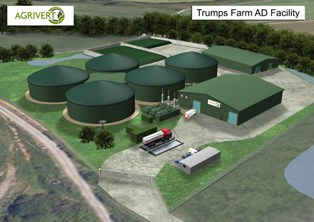
Surrey currently has no ABPR (Animal Bi-Product Regulations) compliant facilities capable of treating food waste. Oxfordshire-based organics recycling company Agrivert hopes to supply Surrey with the infrastructure required to treat local commercial and municipal waste, whilst generating over two megawatts (MW) of renewable electricity enough to power 4,000 households. The AD plan will also produce digestate which Agrivert says is a valuable agricultural fertiliser which will benefit local farmers.
The facility was considered acceptable on the proposed site, despite being located within the Surrey Green Belt, and was granted planning consent by Surrey county council on 16 November 2011. Waste heat produced during the electricity generation process will be reused within the AD system and the remainder will be used to dry waste wood, which will then be chipped and pelleted for use in domestic, commercial and industrial wood fuel boilers.
Planning permission granted for Devon AD facility
AAD (South West) Ltd, a subsidiary of British engineering company the AeroThermal Group Ltd, has been granted planning permission by Devon county council to develop a 15 million anaerobic digestion facility on a redundant china clay refinery site at Lee Moor in South Devon.
Operating under the trading name AAD (South West) Ltd, the facility will use a unique combination of industrial autoclave processing and anaerobic digestion technology to separate out materials from mixed waste for recycling, generate 26 gigawatts-a-year of electricity, and produce a compost-like material which will be used at the nearby Imerys Minerals Ltd Lee Moor China Clay workings as part of an ongoing restoration programme. The plant is expected to divert up to 75,000 tonnes of waste from landfill every year.
Commenting on the proposal, AAD (SW) Ltds managing director, Tristan Lloyd-Baker, said: We are delighted to receive the green light by way of planning approval for our proposal and I would like to thank all those involved in supporting us. Our intention is to begin construction in early 2012 with a view to being fully operational from April 2013.

Register for free to comment