

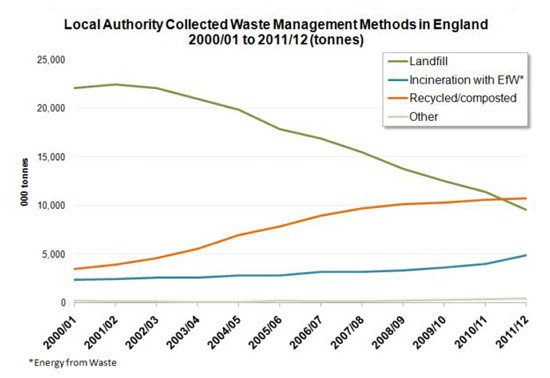
More wastewas sent for recycling by councils in England than to landfill in 2011/12 for the first time since records began, according to data published today (November 9).
However, the rate of increase in recycling performance appears to be levelling off, suggesting that local authorities are facing challenges in increasing recycling rates further.

Final figures released by Defra for the 2011/12 financial year show that 10.7 million tonnes (42%) of local authority collected waste was sent for recycling, composting or reuse by councils, compared to 9.6 million tonnes (37%) which went to landfill. Local authority collected waste is largely made up of household waste, but also includes some commercial material.
Commenting on the recycling tonnage, Defra said: This amounted to more than was landfilled for the first time since records began, although an increase in incineration may have partly accounted for the change in landfill.
When looking at household waste on its own, the figures show that 9.9 million tonnes (43%) was recycled in 2011/12, up just1.5 percentage pointscompared to 2010/11, when 41.5% was recycled. This suggests that many of the ‘quick wins’ in improving recycling performance have been won.

“More still needs to be done and we continue to push towards our aim of a zero waste economy”
Lord de Mauley, Defra
Defra commented: This year on year increase was the smallest for ten years; the rate of increase has been slowing since its peak around 2005, which could indicate that authorities have by now exploited the easiest targets in terms of recycling, and are increasingly facing challenges in influencing behaviour change and identifying new areas and efficiencies in the waste services they provide.
Mauley
The recycling improvement was welcomed by resource minister, Lord de Mauley, but he warned that more needed to be done.
He said: Across the country, people are cutting the amount of waste going to landfill by recycling more. They are not only protecting the environment, but fuelling a growing industry that reuses the things they throw away.
More still needs to be done and we continue to push towards our aim of a zero waste economy, with businesses, councils and householders all doing their bit.
At Local Authority level, individual recycling rates ranged from 14% to 69%, with Vale of White Horse in Oxfordshire being crowned as the top-performing council as anticipated by letsrecycle.com (see letsrecycle.com story).
Meanwhile, Ashford borough council was the worst-performing local authority.
Carbon
The data was derived from quarterly returns from local authorities to the WasteDataFlow database and for the first time also includes a table showing the carbon impact of local authority waste management in carbon dioxide terms in 2011/12.
This shows the relative benefit of recycling materials such as paper and card, metals, organics and textiles compared to the overall negative impact ofmanagingresidual waste through landfill and incineration.
Defra says: Taken as a whole, the management of waste by Local Authorities saved 4.3 million tonnes of CO2 equivalent in emissions. Recycling, reusing or composting materials instead of landfilling them prevented an estimated 6.9 million tonnes CO2 equivalent.
Related Links
“Incineration and landfill of residual (black bag) waste produced an estimated 2.7 million tonnes of emissions in CO2 equivalent.


Register for free to comment