

The fire trials, which began in January, have been carried out on various types of waste material in Yorkshire and Cory Environmental’s landfill site in Barling, Essex.
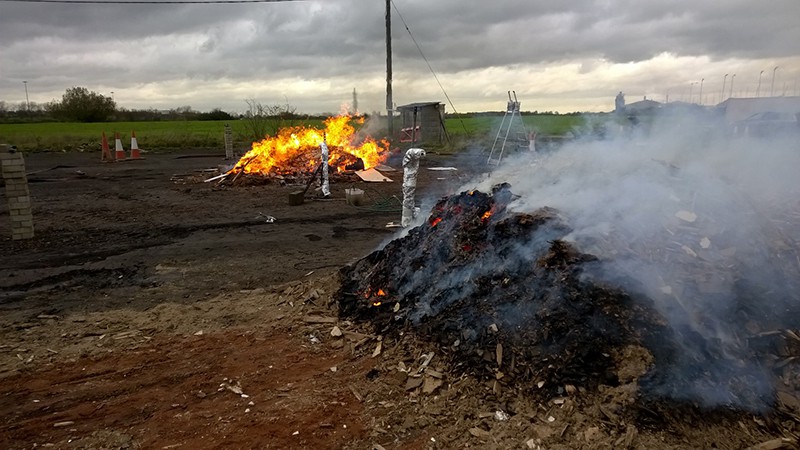
Working in conjunction with the Chief Fire Officers’ Association (CFOA), the Waste Industry Safety and Health forum’s tests have provided an overview of the combustible properties of waste stacks, including rubber, frag fluff, RDF, SRF, raw wood, wood fines, and crushed and screened wood.
Initial findings presented at the Essex County Fire and Rescue Service HQ in March have revealed how often the waste material is turned over could be more important to preventing deep-seated waste fires than stack sizes or separation distances (see letsrecycle.com story).
Now, Mr Jones has suggested that firefighters have already learnt enough from the tests to be able to identify the best ways to tackle a blaze depending on where it has ignited.
Speaking to letsrecycle.com, the WISH chair said that while the tests had been delayed by adverse weather conditions, the group were now looking beyond July 2016 to the next stage of the scientific investigation.
Self-ignition
He said: “We suspect that self-heating is an element of it. When we finish the live burns we are going to pile the waste up and measure the change in temperature over a course of a year.
“There seems to be two heating peaks within a waste pile, the first wave occurs with aerobic degradation when the pile is oxygen rich. The second heat peak happens during anaerobic degradation when the pile is oxygen deficient.”

Mr Jones went on to explain that the tests had also uncovered a fierce “vortex” phenomenon – whereby two waste stacks burnt closed together created a chimney effect, sucking up oxygen in a column. WISH and CFOA are now testing whether interlocking waste bales would remove such risks when stacking.
He added: “Causes for fires are multiple but we are starting to understand how it works. For instance we need to get the public to exclude lithium batteries from household recycling, which has come with advances in mobile phone technology. Damage from RCV compactors can cause them to short which can cause them to ignite in waste piles.”
Plan
Mr Jones hopes that eventually the findings of WISH and CFOA will be incorporated into the Environment Agency’s updated Fire Prevention Plan guidance, but “it is up to government whether they listen”.
Earlier this week, the Environment Agency revealed that it had rejected 65% of Fire Prevention Plans submitted by waste operators since July 2015 – but that the acceptance rate was improving. It warned that publication of the upcoming revised guidance would be delayed due to the “complexities” involved in addressing feedback from operators (see letsrecycle.com story).

Register for free to comment