


Long-awaited guidance detailing what measures waste operators can take to prevent fires has been released for consultation today (June 27).
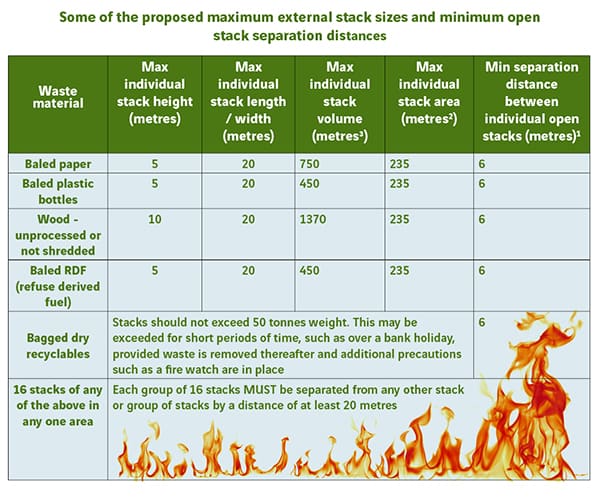
The draft fire control guidance, which applies to waste sites where more than 50 cubic metres of solid combustible waste material is stored at any one time, includes specific storage, separation and stack size information for specific sectors within the industry.

For instance, stacks of baled materials including RDF, paper, unprocessed wood, plastics and tyres should not be more than 5 metres in height, 20 metres wide, with an individual separation distance of 6 metres between them.
Meanwhile, screened and unscreened wood chips should ideally be stored in bunkers or enclosures as soon as shredding is practical, with stacks weighing no more than 100 tonnes and stored for a maximum of three months.
And, stacks of mixed recyclables, loose paper and loose hard plastics should not exceed 50 tonnes with a timeframe for storage to be agreed with an environmental regulator on a case by case basis.
Comprehensive
The comprehensive 89-page document has been prepared over the course of six months by the Environmental Services Association in conjunction with the Environment Agency, HSE, and the Chief Fire Officers Association.
For ease of reading the document has been split into two parts; the first section covering generic issues regarding scope and fire risks, while the second part covers specific fire control information in four areas: whole site issues, issues in reception areas, treatment issues, and the storage of wastes.
In order to gauge views on the guidance, the Waste Industry Safety and Health (WISH) forum has today sent the document to regulators, insurers and those in the industry for comment.
WISH has stated it expects most comment to be on the specifications outlined for stored waste stack sizes and separation distances. It also suggests that the use of more advanced fire prevention measures might help companies achieve permission for the longer external storage of waste.
Testing
The organisation has also conceded that a lack of available fire testing or science specific to wastes means there is no firm underpinning for stack sizes and separation distances, with current recommendations based on operational and firefighting experience.
However, earlier this week the ESA confirmed that further testing to determine the combustion properties of waste is due to be conducted later this year which is likely to lead to further revision of the guidance (see letsrecycle.com story).
Due to the urgent need for sector-specific guidance, respondents to the consultation will have only until July 25 this year in order to voice their opinions.
If approved, the document will replace the Environment Agencys technical guidance note that was produced in response to a spate of high-profile blazes to hit the industry in 2013 (see letsrecycle.com story).
Safety
Commenting on the publication, an ESA spokeswoman said: Through the Waste Industry Safety & Health Forum (WISH), ESA has worked with regulatory bodies to offer guidance on the steps that should be taken by operators to maintain an appropriate level of fire safety on site.
Related Links
The basic premise of the guidance is that it is unacceptable to store combustible waste material in large and uncontrolled piles, and of key significance, the draft guidance recommends maximum stack sizes and minimum separation distances in the absence of anything other than the most basic fire precautions on site.

Register for free to comment