
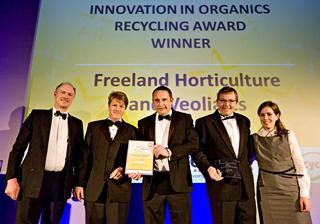
The finalists include local authority partnerships in Croydon and Wigan as well as site managers from Oxfordshire and Perth. Also among those shortlisted are anaerobic digestion plants in Wiltshire and Dorset. A full list can be seen below.

There are seven awards and these will be handed out at a gala ceremony at the Heythrop Park Resort in Oxfordshire on March 21 following the annual conference of the Organics Recycling Group (formerly the Association for Organics Recycling). Topics at the conference will include proportionate regulation and End of Waste. Full details can be found here.
Jeremy Jacobs, technical director of the REA and chair of the judges, said: I am delighted to present such worthy finalists for the organic recycling awards, the quality and diversity of entrants this year made the selection very challenging!
Organics Recycling Conference 2013
There are a few places left for the Organics Recycling Conference and Awards 2013 which is taking place in Oxfordshire on March 21 2013. Book now to avoid missing out! For more information click here.
LOCAL AUTHORITY PARTNERSHIP AWARD
This award recognises measures taken by a local authority and processing company to deliver an efficient service which offers excellent value for money.
This years finalists are:
- Wigan Council, FCC Environment and TEG Environmental: This partnership worked together to reduce the level of contamination within the green waste collection and managed to create a significant decrease in the number of loads rejected. The approach centred on increasing awareness among customers and educating refuse collection workers about the composting process. Judges were impressed with the results and how focused the partnership was.
- Croydon Council, Veolia Environmental Services, Viridor and Bio Collectors: This four-way partnership achieved an impressive diversion of food waste from landfill by introducing a food waste collection service to 120,000 houses and 26,000 flats in early 2012. Areas of collaboration included jointly hosting media engagements and training council resident engagement teams. As a result, the partnership helped to achieve 755,000 in landfill savings. The Judges commended the outstanding results of this scheme in what is a tough urban climate.
FOOD RECYCLING AWARD
In this category, entrants must consider the application of the waste hierarchy in the way they process food waste, diversion from landfill and the impact it has on reducing greenhouse gas emissions.
This years finalists are:
- Fresh Olive and WasteSolve: This supplier of Mediterranean food products to the trade and retailsector worked with WasteSolve, the environmental consultancy arm of recycling company Cawleys, to review its waste management practices. With a big focus on staff training and engagement and inspired by the work of its customer Adelie, the company put in place systems to segregate waste and within two months achieved zero waste to landfill and a 87% recycling rate, while reducing CO2 emissions. The judges were impressed by the novel approach to communications in this entry as well as the potential cost savings.
- Keenan Recycling: This Aberdeenshire recycling company currently processes around 10,000 tonnes of food waste at its site in New Deer and collects food waste from more than 500 businesses, as well as local authorities. The business service allows companies to recycle items ranging from leftover food to coffee grounds and paper towels and cups, while reducing landfill costs. This has resulted in big reductions in CO2 emissions. The judges praised the bright and forward-looking approach of Keenans and the number of businesses it serves.
ORGANICS RECYCLING SUPPLIER AWARD sponsored by TEG
This award is open to all manufacturers of machinery, equipment and service solutions used in the processing of bio wastes and should demonstrate what its unique features are in the market. It is open to specific items rather than aggregated systems.
This years finalists are:
- Fre-energy: This Wrexham-based manufacturer has developed the worlds first AD system designed to process wastes that contain grit. The patented AD technology includes an auto de-gritting system which enables the continuous extraction of grit from the digester removing the need to periodically empty the tank. The judges were impressed with the unique and innovative design of the system.
- Terberg Matec UK: This manufacturer developed the Plastic Bodied Utility Vehicle (PBUV) which has a smaller footprint than other vehicles, making it ideal for collection of food waste from areas with a lower population density or restricted access. Built from PP5 polypropylene, the plastic body is not susceptible to erosion due to chemical attacks from the waste stream and is fully recyclable at the end of its life. The judges praised the customer service offered by Terberg and the vehicles ability to access difficult areas.
AD OUTPUT AWARD
This category is open to any company operating an anaerobic digestion facility which is producing, supplying, and marketing heat and biogas derived resources.
This years finalists are:
- Eco Sustainable Solutions: Piddlehinton Farm: This firms facility in Piddlehinton, Dorset generates 498kW per hour of electricity which is exported through a private line to the neighbouring Mole Valley Feeds cattle feed mill. When this is not operational, the power is fed into the national grid. The facility also provides biogas to the mill. Digestate produced by the facility, which is in the process of gaining PAS 110 accreditation, is used by two local farms. The judges praised the good use of the plants outputs by local businesses.
- Malaby Biogas: In July 2009, this AD firm saw the opportunity to develop AD technology as an integrated part of a wider regeneration project in Bore Hill Farm, Wiltshire. The scheme connects an AD plant with a commercial development meaning power and heat generated by the facility can be utilised by the on-site businesses. The plant produces up to 1,000kW per hour of renewable heat and 500kW per hour of electricity. The judges were impressed with the integrated approach.
SOURCE SEGREGATED COMPOST AND DIGESTATE MARKETING AWARD
This award recognises the work that producers of compost or digestate from source segregated inputs put into marketing their products, researching and generating new markets for the material, as well as promoting the benefits and using the outputs.
This years finalists are:
- Agrivert: This Oxfordshire-based company is one of the only UK firms to achieve both PAS 100 and PAS 110 for the outputs from its facilities. The companys Cassington and Wallingford AD facilities have low retention times which minimises the odour produced by the end product as well as the residual gas levels, meaning it has been able to find paying markets for the digestate. The judges commended Agriverts focus on the quality of the products and its ability to gain payment for the digestate.
- Forth Resource Management: This company has six sites across South East Scotland. Owing to growing demand in the retail market, Forth has reduced the amount of compost sent to agriculture and has diverted into its retailer division Caledonian Horticulture. In 2010 it produced and sold 20,000 tonnes of organically enhanced topsoil. The firm also started up Growing Forth, a social enterprise which offers opportunities for young disadvantaged people. The judges were impressed with the social benefits as well asFRM’s market focus.
SEPARATED ORGANIC MATERIALS TO LAND AWARD – sponsored by Veolia Water Organics Recycling
This category is open to MBT manufacturers and companies supplying separated organic materials and mixed waste compost. Entrants must demonstrate how they found land based uses for the material.
This years finalists are:
- 4R Group: This environmental consultancy and waste management firm has used separated organic materials (formerly compost-like outputs) from mechanical biological treatment facilities (MBTs) on nine separate projects, with more expected to start in the spring. 4R has also secured contracts with Shanks Waste Management which will see it recycle up to 65,000 tonnes of separated organics materials from 2015. The judges commended 4Rs technical and expert approach to end markets.
- Global Renewables: This operator is carrying out a series of trials and projects to demonstrate the beneficial properties and uses for the organics materials produced by its MBT plants in Farington and Thornton. Its aim is to improve the understanding and acceptance of the products. The judges praised its work in trying to gain acceptance of material produced by MBT plants.
SITE MANAGER AWARD – sponsored by Energy & Utility Skills
This award recognises the work of site managers within the organics recycling industry. Entrants must show how they have transformed and expanded their site and improved standards and outputs.
This years finalists are:
- Neil Pollington – Agrivert: Neil Pollington joined Agrivert in April 2011 as site manager of the IVC site in Ardley. During his time as site manager, the number of complaints regarding odour reduced significantly, with none being substantiated. He achieved this by re-examining the processing of material on site and undertook a number of measures to address this. The judges praised Mr Pollingtons work to reduce odour on the site and his voluntary work within the community.
- Ron Smith – TEG Environmental: Ron Smith has been responsible for organic recycling operation at Binn Farm in Scotland for the last nine years. He has overseen the site during a number of changes of ownership and technology, during which time he has ensured that operations are running smoothly. The judges praised Mr Smiths presence and work within the community as well as his professionalism.
The Awards evening follows on from the annual conference for the organics sector and is run by the Organics Recycling Group of the Renewable Energy Association.

Register for free to comment