


Stuart Hayward-Higham, technical development director at waste management company Suez and the former chair of the Advisory Committee on Packaging chair, Phil Conran both highlighted key points after the document was published on Saturday (26 March).
Defra made the rare move to publish consultation responses on a Saturday ahead of the purdah period, which starts today (28 March).
Costs

Phil Conran pointed to the falling costs of EPR from £2.7 billion to £1.7 billion, and also said the scheme administrator will be appointed from the public sector, but says the government “still wish to see significant industry involvement”.
Mr Conran also noted confirmation of a delay to the rollout of the system from 2023 to 2024, saying:” This will involve partial EPR implementation from 1st April 2024 relating to local authorities costs; and full implementation of EPR in 2025 based on modulated fees”
Mr Conran also highlighted that the PRN system will continue, with a separate consultation on improvements to the system also being launched. His highlights in full:
- The governments say the overall annual costs of EPR will reduce by £1billion from £2.7billion in the consultations to £1.7billion in today’s docs.
- The EPR Scheme Administrator (SA) will be classified within the public sector [thus NO bidding process for a producer-led SA]. The govts still wish to see significant industry involvement.
- EPR implementation delayed a year from 2023 to 2024. This will involve partial EPR implementation from 1st April 2024 relating to local authorities costs; and full implementation of EPR in 2025 based on modulated fees.
- England and Northern Ireland will not introduce litter payments by obligated producers for packaging that is littered (payments for packaging in street bins look set to continue). Scotland and Wales will be forming their own proposals for payments relating to litter.
- The current PRN de minimis threshold for payments will be retained: £2m turnover and 50t of packaging. BUT, for reporting purposes, all companies with £1m turnover and 25t of packaging will need to report data.
- All compostable and biodegradable packaging will have to bear a label saying ‘Do not recycle’ until evidence says it can be collected and composted separately.
Materials Targets for 2024 and 2030
- Materials targets for 2024 and 2030 need to reflect final decisions on DRS systems (e.g. glass targets under EPR increased because glass will be exempt from DRS in England and Northern Ireland).
Local authorities
Mr Hayward-Higham explained that street bins will be included in local authority fees for EPR payments, but pointed to Defra’s stance that litter will not be included in England and Northern Ireland.
He highlighted the following points on Twitter:
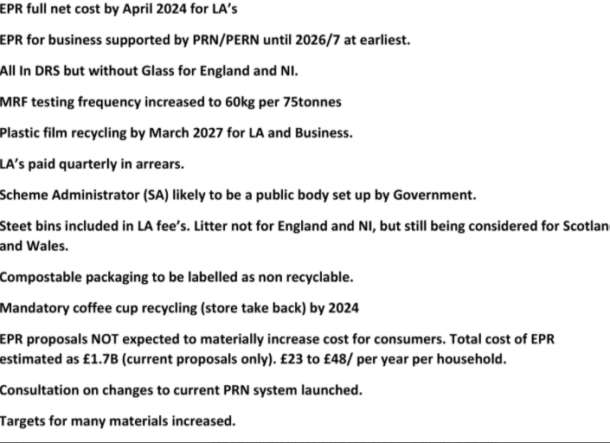
- EPR full net cost by April 2024 for LAs
- EPR for business supported by PRN/PERN until 2026/7 at earliest
- All in DRS but without Glass for England and NI.
- MRF testing frequency increased to 60kg per 75 tonnes
- Plastic film recycling by March 2027 for LA and Business
- LAs paid quarterly in arrears
- Scheme Administrator likely to be a public body set up by Government
- Street bins included in LA fees. Litter not for England and NI, but still being considered for Scotland and Wales.
- Compostable packaging to be labelled as non recyclable.
- Mandatory coffee cup recycling (store take back) by 2024
- EPR proposals NOT expected to materially increase cost for consumers. Total cost of EPR estimated as £1.7 billion (current proposals only). £23 to £48 per year per household.
- Consultation on changes to current PRN system launched
- Targets for many materials increased.
He also noted that local authorities will be paid in quarterly in arrears.

Mr Hayward-Higham also said Defra’s position that the measures will not “materially increase cost for consumers”, with the £1.7 billion adding around £23-48 per household.
This is despite some suggestions from producers that it could add around £100 a year to food costs.
The reduced costs of the system come after Defra dropped its proposals for the collection of business waste. Mr Hayward-Higham highlighted that this will see businesses supported by PRN/PERN until 2026/27 “at the earliest”.

Register for free to comment