


But with trading of WEEE evidence via the Settlement Centre now set to begin on December 18, recyclers have warned that even with the amended legislation, problems with the evidence system remain.

- A tightening of the system of issuing evidence of WEEE re-use;
- A change to require evidence to be issued to the nearest kilogramme, rather than the nearest tonne;
- A right for final holders of household WEEE (such as repair companies) to hand the equipment into a collection point free-of-charge provided consent of the relevant producer compliance scheme has been obtained;
- The extension of the February deadline to April for submitting the previous year's compliance evidence;
- An additional regulation allowing the Secretary of State to publish the acceptable format for records used by distributors.
The changes to the regulations will come into effect on January 1, 2008 – the second compliance period within the WEEE producer responsibility system.
On re-use, the amended Regulations allow producer compliance schemes to offset the re-use of whole appliances against their collection obligations for WEEE. It means that re-using a certain tonnage will count as 100% recycling, but any equipment not re-used will still have to reach the recycling targets set by the WEEE Regulations – the re-use cannot be used to bring up the average recycling rate for all the equipment collected by a scheme.
This means that if 100 tonnes of category 1 WEEE (large household goods) is collected, with 20 tonnes sent for re-use, the remaining 80 tonnes must be recycled to the 80% target level set by Regulation 26. The 100% recycling rate of the re-use cannot be used to bring lower recycling levels of other equipment up to the target level.
Elsewhere in the amended regulations, concerns among producer compliance schemes and recyclers at the inaccuracies of issuing evidence in whole tonnes only has led to the change to issue evidence to the nearest kilogramme.
As well as inaccuracies in the data, this whole-tonne requirement had led to delays for the reprocessing of small loads of equipment within categories like lamps, where only relatively small amounts arise at sites.
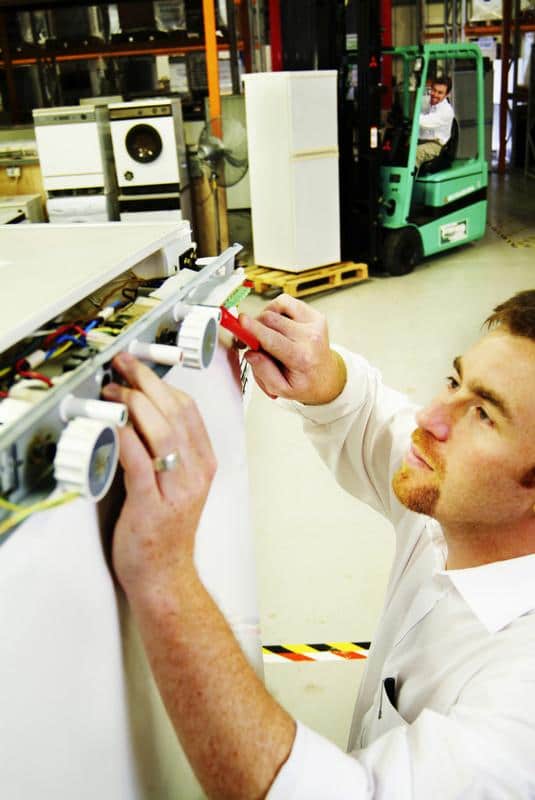
The government has added a new regulation to allow the last holders of domestic WEEE to take the equipment to a collection point (usually a designated collection facility, DCF, but also other places including sometimes AATFs) free of charge, as if they were a householder. This was so that, for example, a repair company unable to repair a household item would be able to deal with it under the WEEE Regulations without incurring extra cost.
But, the repair company doing so would have to get the permission of the producer compliance scheme servicing the collection point in order to take the WEEE there.
The other changes to the Regulations have been mainly administrative or minor amendments based on suggestions from industry. In guidance issued alongside the amended Regulations, BERR said the amended Regulations would not address all issues identified by producer organisations and the regulatory bodies. But, the Department said it would continue to discuss any further changes needed with those affected.
Evidence
BERR said the Settlement Centre – the online organisation co-ordinating evidence and data for the WEEE Regulations – will be updated to take account of the amended Regulations early in the New Year, most likely the second week of February.
As with the evolving Regulations, BERR said the Settlement Centre would remain under constant review, with refinements being made to improve its use.
Recyclers of waste electrical equipment are still not fully happy with the evidence note system for WEEE producer responsibility. A meeting hosted by the Industry Council for Electronic Equipment Recycling this week saw some heated discussions about the difficulties experienced.
Adrian Harding, policy advisor for producer responsibility at the Environment Agency was present at the meeting to explain new guidance on independent auditing, which is expected to be available next week.
The guidance is expected to lay out what is expected of recyclers, but some recycling firms told letsrecycle.com following the meeting there had been a “tremendous amount of confusion”. This particularly related to evidence notes issued for processed WEEE materials leaving a recycling plant, including what happens when the materials are exported.
Concerns were also raised about how the WEEE Regulations fit with this year's new Transfrontier Shipment of Waste Regulations.
Commenting on the issue, Derek Morgan, head of strategy at Bracknell-based IT recycling company CKS Group, said he believed a system of standards was required for materials leaving the UK, and that this could not be just the preserve of the Environment Agency, that assistance from an international standards agency would be needed.
He said: “At the moment there are no standards so how can we compare the outputs from one plant to another? We need a basis for comparison.”


Register for free to comment