


And, the consultancy claims that if development of EfW facilities continues at its current rate, a proposed 70% by 2030 EU recycling target will be impossible to meet, as the UK will limit itself to a maximum 66% recycling by that date.

The claim pitches Eunomia firmly against the belief held by the waste industry, with firms including Veolia and SITA UK all claiming that the UK is on course for a treatment shortfall within the next decade.
Eunomia has today (November 27) published the seventh edition of its Residual Waste Infrastructure Review, in which the consultancy predicts that once operational and planned developments and committed tonnages for export are factored in, treatment capacity will exceed the amount of waste available by as early as 2017/18. Previously it had claimed that this situation was only likely by 2018/19 (see letsrecycle.com story).
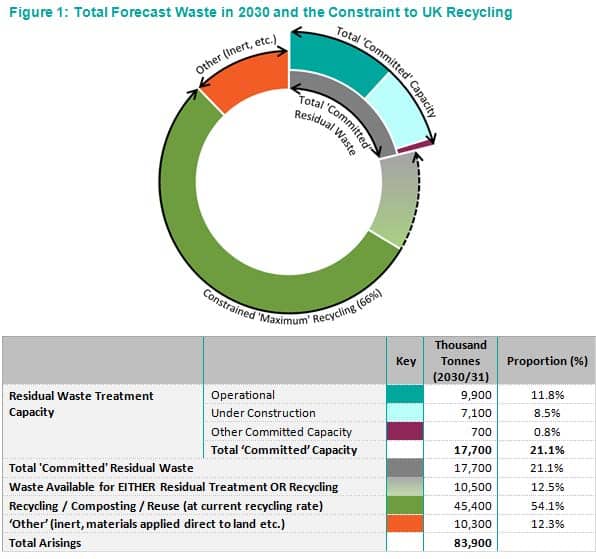
The report claims that currently there is around 9.9 million tonnes of operational residual waste treatment capacity in the UK, with a further 7.1 million tonnes in development, as well as 0.7 million tonnes of other capacity which has reached financial close and is due to start construction.
Capacity
Based on modelling of changes in total waste arisings, Eunomia predicts that there will be a total of 83.9 million tonnes of waste, including recyclable material, available for treatment by 2030/31.
Should all of the planned waste treatment capacity come online, the report concludes, this would leave the UK with a maximum achievable recycling rate of 66%.
Adam Baddeley, the report’s lead author said: “It is important that when investing in major infrastructure we think for the long term. We have already seen a number of northern European countries reach a position where they have more incineration capacity than residual waste.
“The UK is at risk of joining their ranks. Instead of committing further resources to expensive residual waste treatment, we should be looking at how to derive greater value from our waste through recycling. There are clearly investment opportunities in the waste sector, but it no longer seems wise to commit to more incineration that may not be needed for all of its working life.”
The report draws upon data from local authorities’ annual WasteDataFlow returns, Defra’s latest C&I data and Eunomia’s in-house Facilities Database, which holds information on all residual treatment facilities in the UK – both operating and under development. Data is analysed on both a national and regional basis, to provide a detailed picture of where insufficient or excess capacity is anticipated.

Register for free to comment