


Waste consultancy Eunomia has again claimed that the UK will have too much waste infrastructure capacity to treat waste by 2018/19.
The claim continues to put the consultancy at odds with other research including studies by waste management companies who argue that there will not be sufficient infrastructure both for recycling and for energy production.

Eunomias latest figures come in the sixth edition of its bi-annual Residual Waste Infrastructure Review published on June 2. The report draws upon data from local authorities annual WasteDataFlow returns, data on commercial and industrial waste made available by Defra, and Eunomias own database of residual waste facilities operating and under development in the UK.
It focuses on waste which is suitable for treatment at residual waste treatment plants including incinerators, mechanical biological treatment (MBT) and gasification plants.
The latest issue of the report, published today (June 2), estimates that around 5.7 million tonnes of treatment capacity is currently under construction, which once completed will give the UK a total treatment capacity of around 17 million tonnes per annum.
Eunomia also estimates that planning permission has been granted for a further 20.8 million tonnes per annum of treatment capacity, while planning consent for a further 4.1 million tonnes of treatment capacity is being sought.
And, the consultancy claims that even if no further facilities reach financial close the UK would reach a situation of overcapacity of around 0.5 million tonnes by 2018/19.
Eunomia’s UK waste treament capacity forecast to 2018
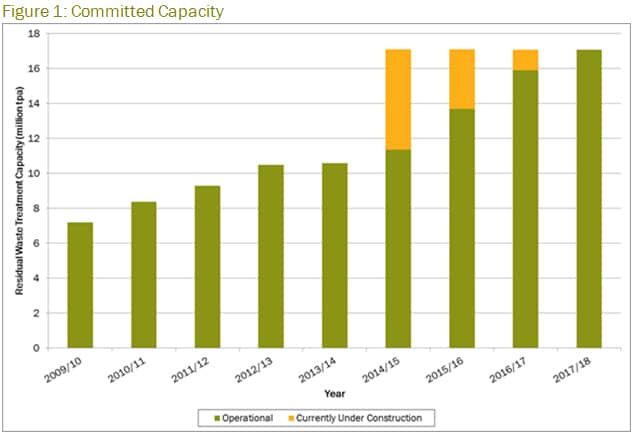
Adam Baddeley, the reports lead author, said: This latest Review demonstrates the speed at which residual treatment capacity continues to grow. In those regions where overcapacity is already becoming an issue, we would expect to see operators charging low gate fees at their facilities to attract waste from further afield. Operators cannot ignore the interactions between supply and demand.
Contrary
The contrary view that the UK could face a shortfall of waste capacity in the future, such as reflected in research by Imperial College and funded by Veolia, (see letsrecycle.com story) appears to be supported by the Green Investment Bank.
Related Links
Chris Holmes, the banks head of waste, told letsrecycle.com in an interview last month that the organisation believes that there is a need for more investment in waste treatment plants (see letsrecycle.com story). Mr Holmes also said that the GIB also hopes to publish data it has collated itself on the likely need for treatment capacity in the UK.

[…] by as early as 2017/18. Previously it had claimed that this situation was only likely by 2018/19 (see letsrecycle.com story). The report claims that currently there is around 9.9 million tonnes of operational residual waste […]