


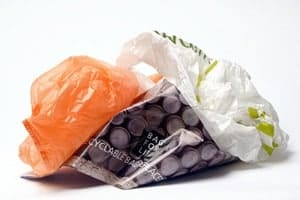
The targets have prompted a British manufacturer of oxo-biodegradable plastic bags, which have been proposed as an alternative to plastic carrier bags, to welcome the new legislation as providing an opportunity to prove the benefits of the material against other types of plastic.

On Tuesday (April 28) MEPs voted in favour of amendments to the Packaging and Packaging Waste Directive – spearheaded by Danish MEP Margrete Auken – to require EU Member States to reduce the usage of plastic carrier bags.
The amendments will allow Member States to choose between measures to reduce annual average consumption to 90 lightweight bags per person by the end of 2019 and 40 by the end of 2025, or to ensure no light plastic bags are handed over free of charge to shoppers by 2019.
Speaking after the legislation was passed this week, Ms Auken said: “This legislation will create a genuine win-win situation. We’re talking about an immense environmental problem. Billions of plastic bags end up directly in nature as untreated waste. It damages nature, harms fish, birds, and we have to get to grips with this.”
The MEP has already unsuccessfully attempted to insert an outright ban on oxo-biodegradable plastics in EU legislation, a move blocked when the legislation was debated in November last year.
[testimonial id = “226” align=”right”]
However, the final version of the Directive, which will be adopted as EU law from next month does include requirements for the Commission to assess the environmental impact of oxo-degradable plastic materials, and to legislate on whether the material can continue to be used in the EU.
England
In England, legislation has already been passed which will require retailers (of 250 employees or more) to charge 5p for every single use carrier bag handed out from October 5. Similar charges are already in place in Northern Ireland, Wales and Scotland.
Controversially, the English legislation contains provisions for a review of industry standards for the biodegradability of plastic material – with a potential exclusion for ‘biodegradable’ plastic carrier bags from the charge, if a suitable standard can be drawn up.
This is despite opposition from the plastics recycling industry to an exemption for biodegradable bags, with the industry arguing that mixing bio and non-biodegradable plastics will compromise the quality of their end products.
Defra has outlined its stance on biodegradable bags saying: “We recognise that there will always be a need for some form of single use bag for impulse buys. For these bags our aim is a genuinely biodegradable plastic bag that meets defined criteria and which can also be identified and separated in waste recovery and treatment operations. We are not aware that such a plastic bag currently exists.
“We are working with industry and academic experts to review existing standards for biodegradability. We will report to Parliament in October 2015 on whether there are suitable standards that could be applied to biodegradable bags for them to be exempted from the 5p charge.”
Alternatives
At present two different types of biodegradable plastic have been put forward as suitable for the exemption, these are:
- Compostable-biobased plastics designed to biodegrade in industrial composting or AD;
- Oxo-biodegradable made from polymers such as PE and PP containing extra ingredients.
Critics of oxo-biodegradable plastics claim that the technology cannot truly be considered ‘biodegradable’ as they state that the material only breaks down into smaller particles and does not degrade entirely, thus not mitigating harm to the environment.
Some producers of oxo-biodegradable have long disagreed with makers of compostable bags – with claims from each side that the others’ technology is unsuitable for use in carrier bag manufacture and harmful to the recycling process.
Symphony
Symphony Environmental is a British firm which manufactures oxo-biodegradable bags and has lobbied the UK government to include the material in an exemption to its bag charge. Symphony strongly denies that the material is harmful to the environment and has commissioned studies which it claims demonstrate that the material can be recycled alongside other types of plastic.

The firm has strong policy awareness with MEP links through board member and South East England Conservative MEP Nirj Deva and former Tory MEP Lord Callanan, who joined Symphony as a consultant in December 2014, having left the European Parliament earlier in the same year.
The company’s deputy chairman is Michael Stephen, a former Conservative MP for Shoreham, who is now Symphony’s commercial director and has welcomed the opportunity to demonstrate the quality of oxo-biodegradable plastics both to the European Commission and the UK government.
Study
Speaking to letsrecycle.com, Mr Stephen said: “We are happy that oxo-biodegradable bags have not been banned. We also welcome the request to the Commission to make a study of oxo-biodegradable bags in the commitment. We are going to demonstrate to the Commission that oxo-biodegradable doesn’t just fragment and that it does become a degradable material.”
He also argued that oxo-biodegradable bags are not harmful when entering the recycling process, and pointed to a study carried out by scientists at the Roediger laboratory in South Africa, which it is claimed backs up Symphony’s assertion.
He said: “Defra has to see if there is a type of environmental bag that will biodegrade in the open environment faster than a conventional [bag] does. I have explained to Defra that oxo-biodegradable plastic does meet that criteria.”


Register for free to comment