

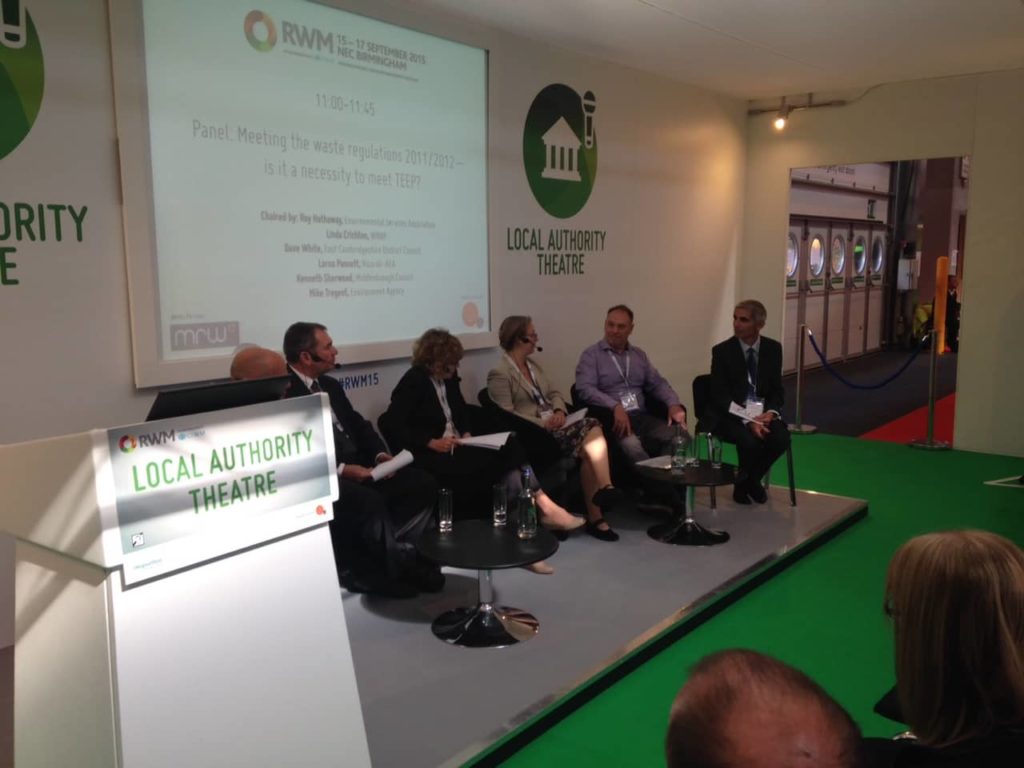

Mike Tregent, the Agency’s waste stream assessment officer outlined the Agency’s work to assess the progress councils have made towards meeting the requirements of the Waste (England and Wales) Regulations, during a panel discussion at the RWM Exhibition at Birmingham’s NEC on Thursday (September 17).
The Regulations, which came into effect for businesses and councils from January 1, stipulate that materials such as paper, metal, plastic and glass must be collected separately if it is necessary to do so to encourage high quality of the recycling of the material.
Councils may continue to collect the material in a single ‘commingled’ stream, if it is possible to demonstrate that separate collections are not technically, environmentally or economically practicable (TEEP).
Compliance
The Environment Agency sent out a reminder to businesses and local authorities in December reminding them of the requirements of the regulations as well as outlining a series of indicators to identify the risk of non-compliance with the law.
[testimonial id = “278” align=”right”]
This has been followed up by a survey of local authority collection models, which will seek to identify areas where there might be a risk of non-compliance, findings of which are currently being assessed.
Mr Tregent said: “We have conducted a survey of local authorities asking them how they intend to meet those requirements. That will be published in the autumn.
“In terms of how we intend to regulate; it is individual and it is meant to be sophisticated. We want to focus on the actual outcomes which are high quality recycling and meeting our [recycling] targets. We don’t want to do that by chasing down every single district and saying ‘this or that is wrong’, we have to look more broadly.”
Quizzed further on the Agency’s approach during the question and answer session after his presentation, Mr Tregent said that the enforcement body was keen ‘not to go down the legal route’ but conceded that it may have to consider such action if a ‘blatant and consistent’ breach of the regulations occurs.
Councils
Earlier in the panel session, local authority officers Dave White of East Cambridgeshire and Kenneth Sherwood of Middlesbrough, outlined the work their councils had completed to ensure that they are compliant with the regulations.

Both councils opted not to move away from commingled recyclable collections after having assessed their compliance with the regulations.
Mr White, who is the waste services team leader at East Cambridgeshire, explained that his council was among the first authorities to assess its collection regime in line with TEEP – and noted that East Cambridgeshire was found to have benefited from a boost in the tonnage of material collected since switching from a separate to a commingled system.
He added that the boost in tonnages made commingled collections more economically viable, adding that the increased income from higher quality separately collected material didn’t necessarily cover the higher collection cost.
The panel session, titled ‘Meeting the waste regulations 2011/2012 – is it a necessity to meet TEEP?’ was chaired by Roy Hathaway, policy advisor at the Environmental Services Association (ESA) and also featured presentations from Linda Crichton of WRAP, and Ricardo AEA’s Lorna Pannett. It took place on the Local Authority Theatre on the final day of the 2015 RWM Exhibiton and Conference in Birmingham.


Register for free to comment