

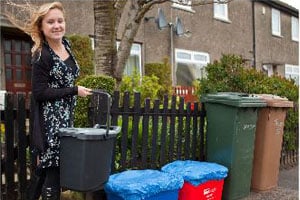
As of September 2012, residual waste will no longer be collected weekly, but will instead be collected on alternative weeks to green waste. Dry recyclables will continue to be collected weekly.

The alternate weekly collection service (AWC) will be rolled out to the 50% of households in the city that already use wheeled bins for waste collection, approximately 160,000 properties. The council said that there were no immediate plans to extend the service further.
The same rear-loader vehicles will be used for collections of both green waste and residual waste. Once collected, the green waste is sent for composting at the Forth Resource Managements Braehead depot and the residual to a waste transfer station in Powderhall, prior to being sent to a landfill site in East Lothian.
Commenting on the service, environment convener councillor Lesley Hinds said: Refuse collections in Edinburgh are being altered in a bid to reduce the amount of rubbish sent to landfill and to encourage households to recycle more. With a large choice of recycling options available, including food waste recycling, we hope that this will reduce the need for affected households – about 50% of the city – to have waste collected for landfill each week.
“These changes will help to reduce the 148,000 tonnes of rubbish we dump at landfill each year, and to raise recycling rates from the current 33.5% to 50% by 2014.
Targets
The council said it was making the changes to help it meet Scotlands national recycling targets which include a recycling 50% of waste by 2013, 70% by 2025 with a maximum of 5% waste sent to landfill. The targets, which are not statutory, are detailed in the Scottish Governments Zero Waste Plan, which was published in June 2010 (see letsrecycle.com story).
As a whole, the country remains some way off these targets. New figures released this week (July 31) show that for the rolling year to December 2011 the household recycling rate was 40.7% (see letsrecycle.com story).
Service
The councils food waste collection service, which was introduced in April 2011, will continue to be carried out on a weekly basis. The food waste collection service is being rolled out city wide next year. The council hopes this will make a significant contribution to reducing the amount of domestic waste thrown away by each household.
Under waste regulations approved by the Scottish Parliament earlier this year councils in Scotland must provide food waste recycling to all households by January 1 2016 (see letsrecycle.com story).
Edinburgh, through a partnership with Midlothian council, is currently procuring food waste treatment contract, which will begin in 2015 (see letsrecycle.com story). In February the shortlist was cut down to Viridor Waste Management Ltd and Alauna Renewable Energy, a joint venture between Kelda Water Services (a subsidiary of Yorkshire Water) and Scottish Water Horizons.
Related Links
At present food waste is taken to Scottish Water Horizons Deerdykes anaerobic digestion facility in Cumbernauld.
Meanwhile the council said the citys kerbside recycling service, which is operated by Palm Recycling, will stay the same. Dry recyclables in Edinburgh are collected at the kerbside through a series of bags and boxes. Glass and metals are collected in a blue box; paper in a blue bag; textiles in a textile bag; batteries in a clear bag; cardboard in a red box; and plastics in a clear plastic bag.

Register for free to comment