


The group, which funnels profits back into the business, has posted a jump in turnover from 29 million to 47 million in its latest annual report, for 2006.
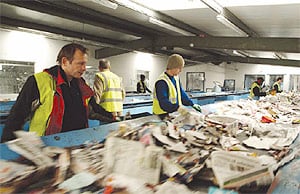 ECT already runs this MRF in Northern Ireland through its Bryson House partnership |
ECT now employs 1,100 staff including its transport activities, but its environmental services contracts make up the largest portion of its turnover, accounting for 33 million revenue in 2006 and a further 6.5 million in material sales.
The seven-year Ealing contract saw the recycling specialists moving into non-recyclable waste collection activities, and the report reveals ECT's intention to build on this by seeking further integrated contracts.
Speaking after publication of the group's latest annual report, ECT chief executive Stephen Sears said: “We are looking to bid for more integrated waste contracts as that is the way the market is going. Councils would like to see more resources going into recycling and less into refuse and believe it is easier to switch resources within a contract.”
“UK-wide”
While gaining the Ealing contract, ECT is losing its kerbside recycling collection presence in both Brent and Waltham Forest (see letsrecycle.com story). However, the organisation said it sees plenty of opportunities to expand away from its London roots.
Mr Sears said: “We're likely to become more UK-wide and not concentrate exclusively on our traditional home ground of London, the West and the West Midlands”
ECT's chief executive added: “I don't see ECT necessarily growing at the same rate as it has done over the last 10 years as there is bound to be ups and downs. But in general terms a social enterprise business committed to both environmental and financial results is a better partner for local authorities as environmental concerns move up the public agenda.”
Commingled
ECT, which is the largest community sector recycling organisation in the UK, told letsrecycle.com it is also now looking to offer more commingled collections to local authorities.
ECT has in the past favoured source-separation for its recycling collections, and has argued against the use of commingled systems, which require materials recycling facilities to sort collected material.
But the group is now responding to what it sees as an opportunity in the local authority waste market to pursue the MRF route.
| Related links: |
It has already gained experience in materials recycling facility operation through its Northern Ireland partnership with charity Bryson House, running a MRF in Mallusk that handles about 40,000 tonnes of material each year.
Mr Sears said: “I don't want to pretend that source-separated recycling is not a better environmental option. The fact that it gets better results is irrefutable. But having said that, for various reasons including the convenience of residents, local authorities are sometimes committed to a co-mingled solution. This is an opportunity for us to provide the best MRFs there are.”


Register for free to comment