

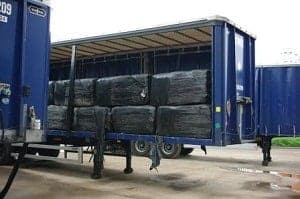
Publishing its response to the recent call for evidence on the RDF export market in England yesterday (December 1), the Department also placed an emphasis on tackling waste crime in the RDF industry and said it would consider the case for financial guarantees or bonds for permitted sites as part of its Waste Crime Action Plan.

However, Defra has ruled out banning or taxing RDF exports, subsidies for energy-from-waste (EfW) plants and tightening the recovery (R1) criteria for the material.
According to the Defra response “some form of government intervention in the RDF market in England is necessary to address existing ‘market failures’” –which it explains is due to recyclable materials sometimes being used in RDF instead of being recycled.
Waste and resources minister Dan Rogerson said that it was “vital” that the waste hierarchy is followed throughout the RDF production chain to “ensure that only residual waste, which has been properly treated, is exported”.
Mr Rogerson added that an RDF definition and treatment standard would be introduced so that “we can be confident that all practicably recyclable materials are removed” and to provide “greater clarity and consistency across the RDF market”.
Apology
Expanding on the Department’s intentions at letsrecycle.com’s RDF Conference in London this morning (December 2), Defra’s residual waste team leader, Deborah Owens, apologised for the delay in publishing both her Department’s and the 47 industry responses following the close of the consultation in May 2014.
She also said that Defra would look to Northern Ireland’s regulatory position statement on mixed municipal waste, published in March this year, as a “starting point” for developing an RDF definition and treatment standard, which she added would “help address quality issues going forward”.
But, she said: “One thing we won’t be doing is introducing a compositional standard.”
Defra has not yet decided whether an RDF definition or treatment standard can be delivered through guidance or whether legislation is necessary.
Ms Owens explained: “We are very, very aware of the cost burdens that something like that [regulatory standards] can put on the industry, so we will work with industry to make sure we get that right.”
[testimonial id = “113” align=”right”]
She explained that RDF exports “provide an important route for waste that might otherwise have gone to landfill” and that therefore Defra had no plans to tax exports or to place a ban on exporting the material altogether, as this “goes against free market principles”.
As well as working with the Environment Agency to tackle waste crime, Defra will also look at bonds and financial guarantees to ensure that RDF produced in England is correctly sent for energy recovery, while production and storage of RDF will require an environmental permit, according to Ms Owens.
Taking questions after her presentation, Ms Owens was asked by Blakeleys Recycling managing director Graeme Knight whether separate collection regulations for businesses coming into force in January 2015 would in fact negate the need for a treatment standard for RDF to remove recyclables.
In response, Ms Owens said: “It is very hard to say what the impact is going to be. We want to review the situation after separate collection has come in and see how it is operating but it should mean that there is less recycling going into the refuse bin.”
Defra’s response comes as exports of RDF from England look set to dwarf last year’s overall tonnage by the end of 2014. The Environment Agency’s most recent figures showed that around 1.8 million tonnes of waste derived fuels were sent for incineration in mainland Europe between January and September this year (see letsrecycle.com story).
Environment Agency
Also speaking at the conference this morning (December 2), senior technical advisor at the Environment Agency, Pandora Rene, said the rise in exports of RDF over the last few years was “absolutely incredible”, which had presented regulators with problems regarding illegal storage of the material.
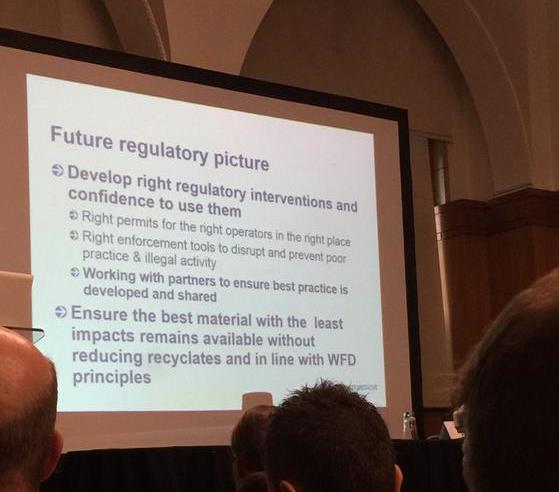
She explained that the EA would be removing the current regulatory position standard (RPS 128) on the short term storage of RDF and would be “bringing in something to cover incidental storage [of RDF prior to export] – and that really is incidental”.
The EA will also consider the option of requiring operators applying for a permit to demonstrate they have a suitable end-user contract in place for their outputs as part of its revised procedures for environmental permits.
Ms Rene said there would be “the right permits in the right place for the right operators” and “no more fudged permits”.
Ms Rene also explained that the export of RDF was a market “in the broadest possible sense” as the material is not sold as such: “There is no price for RDF, it is about the balance of gate fees.”
Next steps
According to Defra’s response to its call for evidence on the RDF export market in England, the Department’s next steps will be:
- To work with the industry, the Environment Agency and the Devolved Administrations to consider a possible definition for RDF.
- To work with the industry to consider a possible treatment standard for RDF including what it should cover, how it should work and how it should tie in with a definition of RDF.
- To consider the potential costs and burdens to operators resulting from introducing a definition and treatment standard.
- If a proposal to introduce a definition and treatment standard results from this work, to consider whether theseshould be delivered through guidance or legislation.
Related Links:
– Responses to call for evidence on RDF export market
– Environment Agency

Register for free to comment