

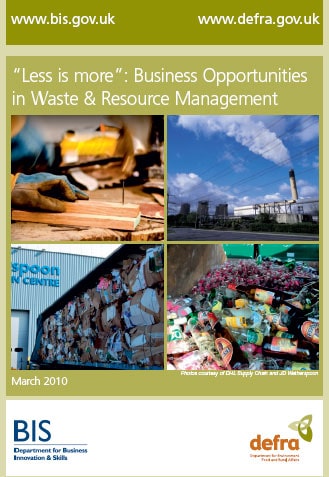

In addition, the report identifies a potential opportunity for the UK manufacturing sector to play an increased role in the construction of waste management infrastructure by helping to develop equipment.
The 24-page document aims to address issues across the waste supply chain from product design to its treatment method and help foster investment in the £6.5 billion waste and recycling sector against the backdrop of a “changing global economy”.
Environment minister Hilary Benn said: “What's good for the environment can be good for business. There are real opportunities for British companies who can lead the way in innovative product design and supply systems. We need to be smarter about re-using and recycling waste, getting the full value from our resources rather than simply dumping it in landfill.”
Key materials
In the document, the government departments identify glass, plastics, card and paper, and food waste as “four key waste streams” and ways in which market development in these areas could be encouraged.
On food waste, the document suggests that increased access to commercial collections and the realisation of 1.7 million tonnes of organic treatment capacity currently in the planning process could prevent a significant opportunity. Furthermore, it suggests application of new technologies and increased use of digestate on land.
For the paper and card sector, Defra and BIS claim that there is the potential for inward investment in the sector, as only five million tonnes of the 12 million tonnes of paper consumed in the UK each year is produced domestically, and it suggests increased collections from small commercial firms.
With regards to plastic and glass, the report identifies the need to develop markets for mixed grades of the respective materials. On glass it is suggested that the work is done to establish the acceptance among consumers of non-standard coloured glass and introduce technology capable of sorting mixed glass.
Meanwhile, the report states that there is a business opportunity for mixed plastic reprocessing capacity to be developed in the UK and it points to work done by WRAP to investigate the commercial viability of the practice on a large scale (see letsrecycle.com story).
SMEs
Tackling waste generated by small businesses is seen as a focal point of the report, with the report keen to highlight the need to introduce improved collection and sorting networks for this area.
Defra and BIS claim this could be helped by proposed changes to the definition of ‘municipal waste', which could create a convergence between commercial and household waste and remove the disincentive for local authorities to collect the material (see letsrecycle.com story).
The report also acknowledges the need to change the perceptions of the waste and recycling sector and – through work by WRAP, regional development agencies and local initiatives – seeks to address barriers preventing small businesses from becoming more resource efficient.
Defra and BIS also highlight that, from experience of the sector, UK businesses could improve resource efficiency and save between four and five per cent of their annual turnover.
By way of example, the report identifies a number of case studies outlining how businesses have managed to save money and resources through dedicated efficiency programmes, such as work between pub chain JD Wetherspoons and DHL.
Business minister Pat MacFadden added: “The waste management sector has a real opportunity to use its expertise to deliver new services in resource efficiency and management. Defra and BIS will join forces to work with industry to transform the perception of waste from a problem which has to be dealt with, to an opportunity to be exploited.”


Register for free to comment