

The overall target has been revised down slightly from the initial proposals circulated by Defra at the beginning of the month – which had suggested a potential overall WEEE collection target in excess of 633,000 tonnes for the year (see letsrecycle.com story).
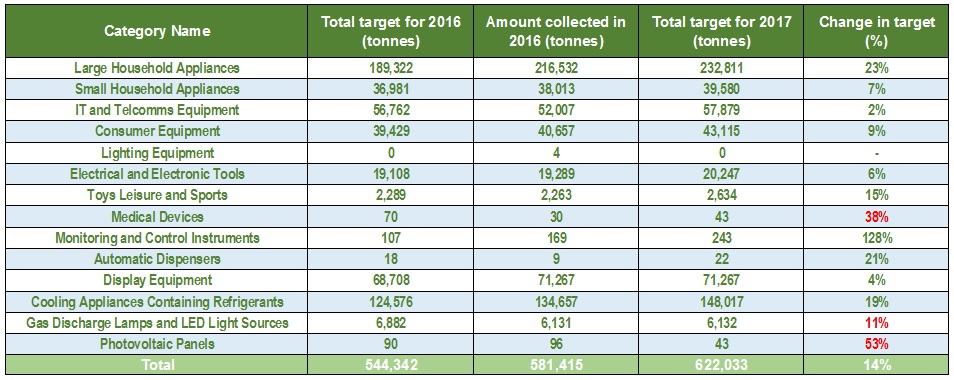
However, the 622,000 tonne goal will still represent an anticipated growth in WEEE tonnages collected of around 14.3% compared to the 2016 target of 544,342 tonnes, and means that compliance schemes will have to collect around 40,000 tonnes more WEEE than in 2016.
The methodology used to calculate the target is based upon the average annual growth in tonnes of WEEE collected for each category since 2012.
Levels
This means that for categories of WEEE such as large household appliances – where collections have increased over the five-year period – targets have been set at a higher level than during the preceding year.
However, for categories such as display equipment, where arisings are diminishing, collection targets are lower.
The lamp collection target for 2017 is also lower than its 2016 level. The target had been set at an increased level in 2016 to take into account an anticipated surge in the tonnages of lamps captured through the WEEE system due to a change in the classification of ‘dual use’ WEEE.
However, schemes had been unable to secure sufficient tonnages of lamps to meet the target, and some will have had to resort to the compliance fee to ensure that their members meet their compliance obligations for the year.
‘Stretching’
Mark Sayers, principal consultant at resource efficiency specialist Ecosurety described the 2017 targets as ‘stretching’ but added that much of the changes in individual targets means that the overall goal is at an achievable level.
He said: “The increase is spread over most categories, which is manageable, and should not have any detrimental impact on the producer market, or create much change for recyclers. Overall, these are stretching targets which reflect recent market trends and dynamics.
“For example, the 8% increase for large household appliances should be easily achievable if metal markets continue to improve through 2017. We also believe the 11% target increase for IT telecoms and equipment will encourage more of the dual-use defined WEEE to be drawn onto the recycling system, as well as provide greater economic value to members who use our new innovative collection systems.”


Register for free to comment