

North of the border, the waste landscape is changing. Scotland’s vision for a ‘zero waste society’ has seen it forge some of the most ambitious proposals in the UK – including household food waste collections in non-rural areas by 2016, a landfill ban on municipal biodegradable waste by 2021, and a 70% recycling target for 2025.

The plan is ambitious. Scotland was eight percentage points shy of hitting its aspirational target of 50% recycling in 2013 – ranking behind England with 44.2% and Wales where 52.5% of household waste was recycled. The failure prompted scepticism from the Scottish Conservative Party, which believes the targets are ‘unachievable’.
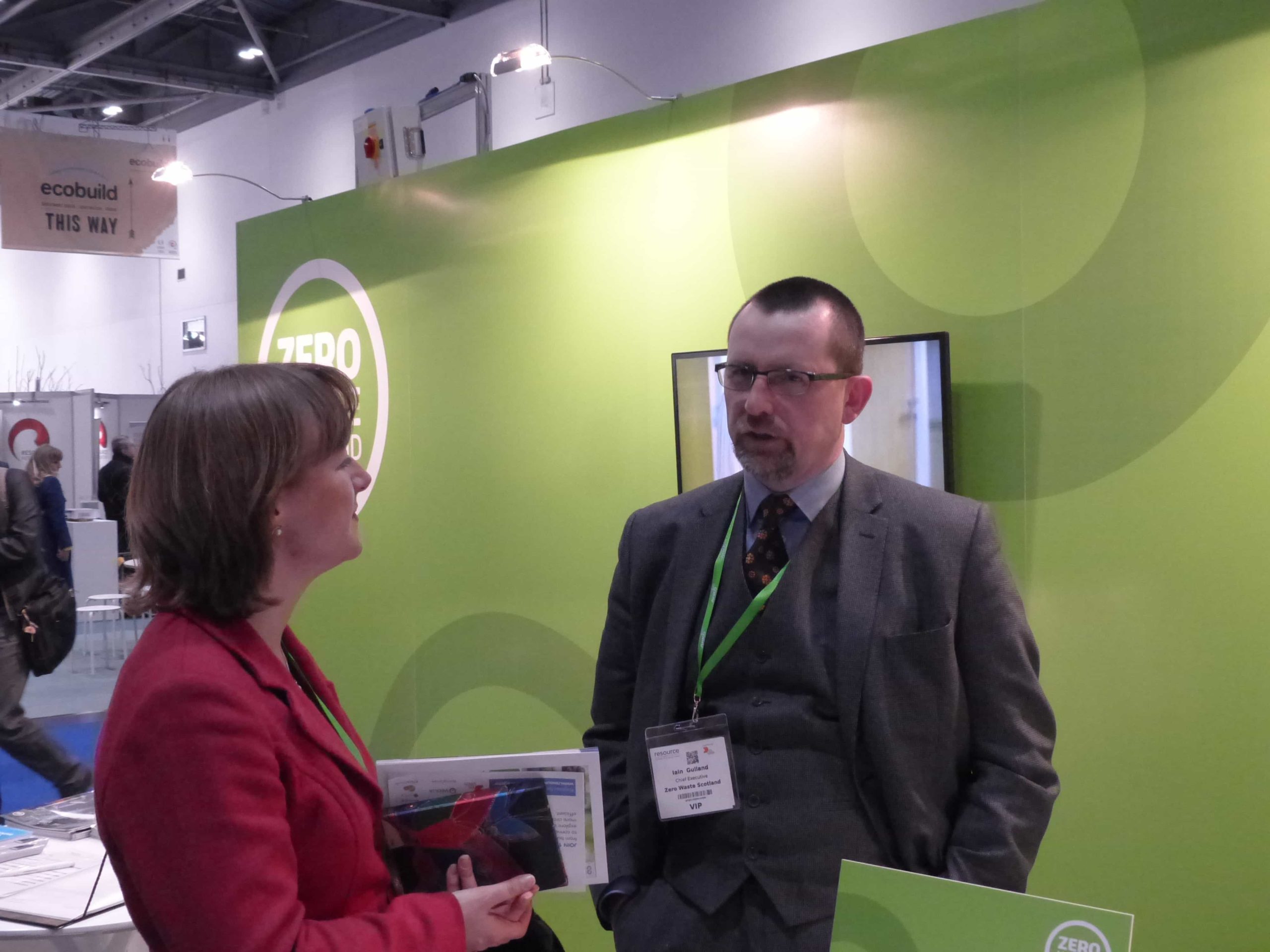
But, it is a series of goals that Iain Gulland, director of Zero Waste Scotland, still thinks his country can achieve. Speaking to letsrecycle.com at the London ExCel Resource event this week (March 4) – Mr Gulland reflected on how far Scotland has come since its Zero Waste Plan was introduced five years ago – as well as the challenges ahead.
Regulations
One of the biggest shake-ups to hit recycling in Scotland has been the introduction of the Scottish Waste Regulations – legislation adopted in January 2014 that requires businesses to present metal, plastics, glass, paper, card and food waste (over 50kgs per week) for separate collection. Failure to comply with the regulations could land businesses with fines of up to £10,000.
The ensuing increase in food waste has given Scotland’s organics recycling sector a boost, as Mr Gulland is keen to point out. “I think the key to it is the fact that businesses in Scotland have come around to what we have been talking about,” he says. “Keenan Recycling has seen a 50% increase in food waste coming in to its facility and employed extra staff, while Shanks has applied to expand its anaerobic digestion facility in Cumbernauld.”

However, some in the industry suggest that the regulations have thrown up new problems for recycling in Scotland. In an article for this website last month, William Tracey managing director Robin Stevenson wrote that whilst it was great to see an increase in the volume of material arriving at the firm’s Glasgow materials recycling facility (MRF), this has been coupled with a 12% rise in contamination levels.
Border
The knock-on effect of course is that cost of processing all this waste to an acceptable standard has also risen significantly. The boost in tonnages also means Scottish reprocessors can be more selective in what material they accept – and there are long-term concerns that some of this waste could be redirected south of the border if the MRFs are operating at full capacity.
Mr Gulland is aware of these concerns, but believes increased investment in Scotland’s waste infrastructure and updates to the MRF code of practice will mean the regulations remain practicable when they are updated in 2016. From January, businesses producing more than 5kg of food waste per week will be required to recycle it.
“The Scottish Government will build the capacity,” he says. “People say contamination has increased because of the regulations, but others will say the contamination was there already. We have just launched our code of practice for MRF quality and that’s part of how we are addressing that. We are ensuring quality inputs and output and I like to think that will help that issue of contamination.”
Landfill tax
There are other reasons why cross-border movements of waste could become attractive in the near future. From April this year, HMRC will devolve landfill tax making powers to Scotland, allowing the country to set its own rates for businesses.
At present the standard and lower rates – which are due to rise to £82.60 per tonne and £2.60 per tonne respectively – remain in line with England and Wales. But the Scottish Government has already announced loss on ignition tests for landfill operators will not be introduced for the first year of the new tax regime – potentially creating a financial incentive for processors to send their waste loads north of the border (see letsrecycle.com story).
Mr Gulland admits the delay in implementing the LOI tests is ‘unfortunate’ but does not believe it will fuel cross-border movements of waste. “Personally I don’t think it will have much of an impact on movement of waste across the border,” he explains. “People are saying it could mean lots of waste coming north of the border but I know it’s something the Environment Agency and SEPA is very conscious of and will monitor it. If Scotland increased the landfill tax it will perhaps have an impact – but this delay is only for the first year.”
Election
With the general election fast approaching, the conversation turns to politics. I ask Mr Gulland what he thinks of the Lib Dems’ pledge to introduce a 70% recycling target for 2030. The Lib Dems have promised a target for England ‘that will fall in line with Wales and Scotland’ – despite coming in five years after the 2025 objective set by the latter nations.
Still, Mr Gulland believes their heart is in the right place. “It’s reassuring that other political parties are wanting to follow Scotland’s lead, and if the whole of the UK went down the same road at the same rate then it’s only going to have a positive impact in the long term.”

Subscribe for free