


According to Machinex, named preferred provider of process equipment last week (see letsrecycle.com story), the 175,000 tonnes per year capacity plant will have 14 SamurAI sorting robots and a further 14 optical sorters.
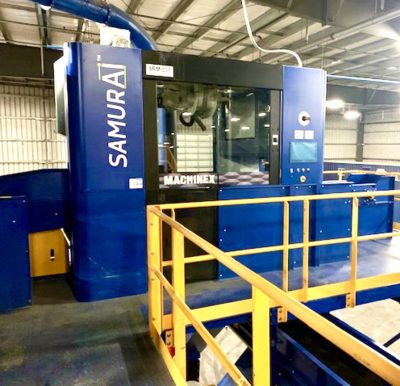
Machinex added that the MRF’s system will allow “real-time interconnectivity between the main sorting equipment”.
This will mean “an extremely minimised level of manpower” with only five manual sorters.
Planning
The Coventry MRF was granted planning permission by Coventry city council on 14 January, and is due to be operational in 2023.
It will be developed in partnership with eight local authorities.
Besides Coventry, the other seven councils involved in the project are Nuneaton and Bedworth borough council, North Warwickshire borough council, Rugby borough council, Stratford district council, Solihull Metropolitan borough council, Walsall council, and Warwick district council. The eight councils believe the MRF will allow them to bring the sorting of their recyclable waste in-house.
It will be operated by Sherbourne Recycling Limited, the wholly owned local authority company established to manage the facility on behalf of the eight partner councils.
‘Leader’
Councillor Patricia Hetherton, cabinet member for city services at Coventry city council, said the facility will be a “leader in the market”.
‘’This facility looks set to be really impressive – a real leader in the UK and in the short term it’s going to help us make sure our waste and recycling service is as efficient as it can be. In the long term, it’s going to enable us to raise our recycling rates. This isn’t just a short-term investment, it’s a long-term investment to ensure a greener future for our city.’’
Cllr Hetherton added that “Machinex employs a sales process that promotes close interaction and collaboration with the council”, thereby “creating the ability to develop sincere partnerships with them”.
She said that by following this approach during the recent procurement process, Machinex was able to understand the needs of the project team and design the ideal future-proofed facility.
Legislation
With legislative changes such as the deposit return scheme, extended producer responsibility and consistent collections set to be introduced in 2023, the future input material of MRFs is likely to change.
“We anticipate the new facility will push recycling performance in the region”
However, Grant McKelvie, project director and Coventry city council commercial business director, said the partnership with Machinex had enabled the company to plan for the future.
‘’Machinex approached this project with a clear vision for a MRF of the future. They understood our vision for a facility that will allow the project partners to effectively manage their risks in relation to their legislative responsibilities, with the confidence their recyclate is being handling in the most efficient and effective manner considering likely changes in the UK waste sector.
“We anticipate the new facility will push recycling performance in the region. This has been an exciting project to be involved in, and I look forward to seeing how it continues to develop.’’
Semi-automatic
Machinex says it will also provide a semi-automatic sampling line to significantly reduce the manpower requirements to execute the daily auditing tasks.
Jonathan Ménard, executive vice president of sales and strategic positioning at Machinex, which recently celebrated its 50th aniversary, said the MRF is the “culmination of years of research, development, and hard work” in incorporating artificial intelligence at the heart of the company’s sorting solutions
He said: “This means that the operations management of this facility will be based, among other things, on the data collected by the AI. The industry has been talking for a few years about the MRF of the future, but this time we can really say that we will make it happen. This will be a game changer and a loud statement within the market”.
Quality
Machinex concluded by saying the the technologically advanced solution will mean the Coventry MRF will be able to deliver higher purity levels of recyclable materials, as well as the flexibility to ensure that it can react to legislation and consumer habits and the introduction of new and changing material steams, such as the low grade plastics separation.


Register for free to comment