



To date the Board, which is chaired by Mayor Boris Johnson, has only issued £1.5 million to support the Recycle for London communications campaign and £100,000 to reuse charity Trinity, despite receiving 170 expressions of interest from councils and organisations (see letsrecycle.com story).
Speaking to letsrecycle.com this week, recycling and waste management officers from London councils expressed concerns about the Board and its focus.
The officers, who asked to remain anonymous, claimed that the fact that the Board was keen to develop larger scale projects meant some councils were put off applying.
One recycling officer said: “It is a lot of money and it is targeted particularly at infrastructure building and only those councils with plans in those areas are going to benefit from it.”
This feeling was echoed by a number of council officers and, in particular, there was an overriding sense that the Board was overly keen on partnership-working between council groups or between councils and the private sector, rather than more local initiatives.
“If we are going to look at larger projects then borough areas working together is a good idea,” added a member of a London council waste management department. “But it needn't be at the total elimination of smaller, local schemes.”
One local authority recycling officer said that emphasis on partnership working – especially with private sector companies – made it seem like local authorities were being “overlooked” as they were unable to acquire funding for “practical” aspects such as refuse collection vehicles and bins.
He added: “It is a bit annoying in that the money is supposed to be for local authorities and not private business.”
Bodies
The minutes state: “At the Authority's last meeting [February 12 2009] the matter of a requirement for all projects to the Board to be partnership based was discussed. Following the meeting the [WLWA] chairman wrote to the Board expressing this concern, and asking for the Board to re-consider this issue.”
The WLWA – which represents Brent, Ealing, Harrow, Hillingdon, Hounslow and Richmond-upon-Thames – is coordinating bids for its respective councils and said it has had to take a partnership approach for these expressions of interest.
The WLWA bids focus on improving civic amenity sites and recycling from flats across the six constituent boroughs.
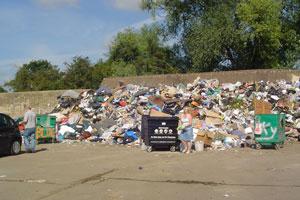
However, it said individual bids from local authorities – such as Harrow's bid for funding for estates recycling and Hillingdon's plans to redevelop its New Year's Green Lane civic amenity site where residents still throw waste on the ground – would be dealt with through a “match-making” process.
Consultants
The comments from the recycling officers came as consultancy Mouchel announced yesterday (October 29) that it had been appointed to provide business support for bidders applying for funding from the Board.
The London-based company has had experience in the waste management sector and intends to work with applicants to ensure that they have a sound business plan in place.
David Goatman, principal consultant at Mouchel, said: “Mouchel is delighted to be appointed as the business support partner for this important initiative and to play a key role in catalysing a new generation of sustainable waste infrastructure in London.
“We will employ our knowledge of the commercial and technical drivers for waste projects to ensure that applicants present the strongest possible business cases for funding.”
Andy Holdcroft, chief operating officer of the Board, said: “We want project proposals to be supported in a consistent, efficient and streamlined manner to ensure only sound business cases are put forward for evaluation and hopefully receive approval for funding.”
Business case
At the last meeting of the Board on September 29, only four business cases had been developed to the stage of being considered for funding (see letsrecycle.com story).
However, not-for-profit organisation London Remade claimed that there were 70 business plans moving into a more advanced position through a development and assessment process.
It added: “The length of time taken to develop a detailed business plan is determined by the complexity of the proposal and its stage of development on submission to the Board.”
Despite the lack of bids to have been approved, one council officer involved in submitting a bid told letsrecycle.com that they did not have concerns about the pace of approvals.
He said: “If you look at timing as a whole we are not in a position to do anything more at this stage anyway and [the Board] has not caused us any problem. We are progressing through the process without it affecting us.”
LWaRB response
Responding to the criticism from some of the local authorities, a spokesperson for LWaRB, smaller schemes would be funded as community based projects. She said: “The London Waste and Recycling Board will support and fund innovative strategic initiatives to complement, not replicate, the work being undertaken by the capital's boroughs and waste authorities. The number of funding agreements is being driven not by the volume of applications but the quality and robustness of those applications, the underlying projects and their sponsors.
“The scale and size of projects has at no stage been set as a criteria against which projects will be funded. We anticipate a handful of large scale projects being funded potentially with cross boundary benefits. In addition to these we would expect a significantly greater number of smaller scale community based project funding such as the £100,000 grant to Trinity, a reuse charity in north London.”

Register for free to comment